
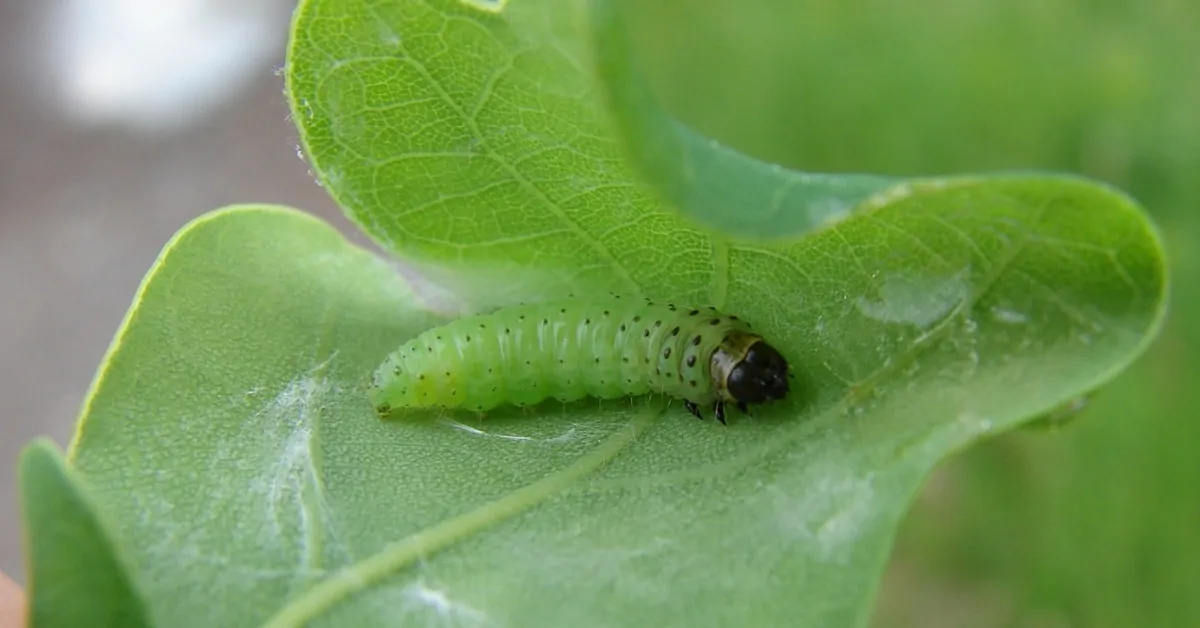
What is the life cycle of the oak green leafroller, from the nearly invisible egg to the small, discreet green butterfly? This spring caterpillar, closely tied to oaks, intrigues walkers as much as it sometimes unsettles them. Yet, despite its appetite for young leaves, it is generally not considered a threat to our forests.
What you need to know
– The oak green leafroller is a common caterpillar in oak forests.
– It mainly feeds on young leaves in spring.
– It is not stinging and poses no danger to humans.
– Its damage is usually temporary, because oaks can regrow their foliage.
– Birds and predatory insects naturally help regulate its populations.
Where does the oak green leafroller live? Habitat and distribution
The oak green leafroller is mainly found in forests where oak dominates, notably in North Africa, Europe, and Asia Minor. In France, this caterpillar is a common species. It tends to appear in spring, when buds open and young leaves become available.
Fascinating in its quietness, it is often spotted by walkers who scout the canopy for hidden life in the understory. The caterpillars can sometimes drop on a silk thread, which makes them more visible during periods of high activity.
Its preferred tree: the oak
Identification guide: the oak green leafroller mainly frequents pedunculate, sessile, or pubescent oaks. It favors tender young leaves, which it may gently wrap with silken threads to shelter and feed.
Although this caterpillar feeds on leaves and shoots, sometimes reducing acorn production, its impact on oak populations is generally limited. The observed damage is often superficial and does not threaten the long-term health of adult trees.
Life cycle of the oak green leafroller: from egg to butterfly
Where does it spend the winter?
The oak green leafroller overwinters as eggs on the branches of oaks. These eggs hatch with the first warmth of spring, often starting in March depending on the region and the weather. Strategically positioned high up, these eggs escape ground predators, increasing the survival chances of the young caterpillars.
The natural sequence: the young caterpillars emerge when the buds open. They feed actively on the young leaves, then gradually transform before giving rise to small discreet green butterflies.
A mild winter can influence caterpillar survival, potentially increasing their numbers in the following spring. However, these year-to-year variations do not seem to affect the overall health of oak forests. The forests’ ability to withstand these fluctuations shows how essential natural regulatory and adaptive processes are to preserving biodiversity.
Is this caterpillar dangerous for oaks or for humans?
Leaves chewed, but trees rarely threatened
Alexis Borges, an entomologist and member of the Technical Committee on processionary caterpillars, told the site Actu.fr, “If winter is milder, there may be less mortality. But there is no reason to panic.”
Natural predators play a key role in limiting oak leafroller populations. Insectivorous birds, certain spiders, parasitoid wasps, and other carnivorous insects contribute to this balance. He also notes that human interventions, such as regular forest maintenance, can strengthen this regulation, helping preserve the ecological balance of oak habitats.
A non-stinging caterpillar
According to the United States Department of Agriculture (and related agricultural authorities), there’s no reason to worry about the health of oaks or our own safety. These caterpillars, though prolific, are neither dangerous to humans nor stinging, allowing their observation without risk for nature enthusiasts.
This phenomenon offers a wonderful opportunity to observe natural cycles. For educators, families, and biodiversity enthusiasts, the oak leafroller provides a concrete example of the role of insects in forest ecosystems.
What to do if you see a lot of caterpillars on an oak?
The right move: in a garden or in the forest, it’s better to watch than to treat. If the tree is mature, vigorous, and well-anchored, a few leaves eaten in spring usually justify no intervention.
Avoid broad insecticide treatments. They risk harming beneficial insects, pollinators, and natural predators that help regulate the oak leafroller.
Biodiversity bonus: letting nature run its course is often the best solution
The presence of the oak leafroller reminds us of one simple truth: a tree is not a fixed ornament, but a habitat. Leaves feed caterpillars, which in turn feed birds, which then contribute to the balance of the garden or forest.
In an ecological gardening approach, it’s better to accept some leaf-chewing. As long as the tree shows no signs of lasting decline, this coexistence is part of the normal functioning of an ecosystem.