
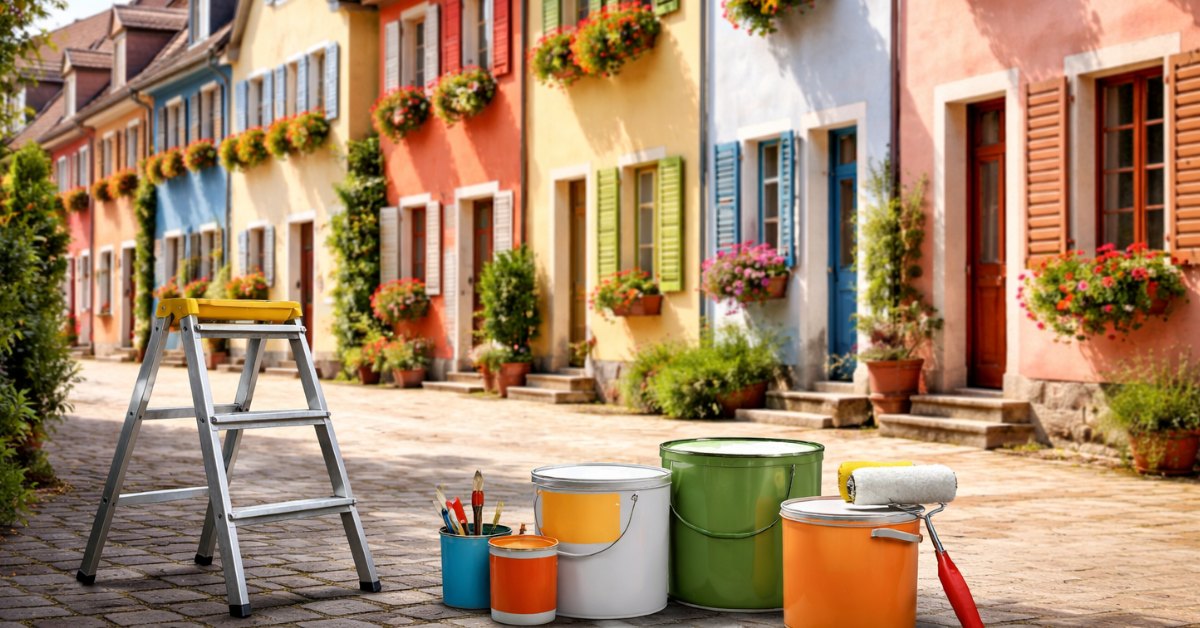
We don’t repaint our home’s exterior every year. Yet, over time, the facade can darken from pollution, dust, or the traces left by rainwater running off the gutters. When the stucco or exterior plaster no longer looks like its original finish, a refresh is in order. But beware: painting or resurfacing a façade isn’t always freely allowed. In some communities, precise rules govern color choices and the work itself.
Before pulling out the brushes, it’s wise to know the legal requirements to avoid having to redo the work… or getting fined.
Repainting Your Home’s Exterior: What Are the Legal Obligations?
In many American communities, the exterior appearance of buildings is regulated to preserve local architectural identity. This is especially true in historic districts, designated historic neighborhoods, or regions with strong architectural traditions.
In parts of the Southwest, for example, color guides may be put in place to preserve typical facades and regional features such as red shutters. In other regions, certain hues are recommended while others are prohibited.
Before repainting your facade, it’s essential to check with your local city hall or planning department. Local rules are usually specified in the Local Urban Plan (LUP), which determines the colors, materials, or types of exterior finishes allowed. In the United States, these are typically found in a city’s zoning code, historic preservation guidelines, or design-review processes.
It is also possible to consult your local CAUE (Council for Architecture, Urban Planning and the Environment) or its American analogue, such as a local design-review board or architectural advisory office, which can advise on the works and aesthetic choices suitable for your home.
In most cases, a prior planning declaration must be filed with the municipality before altering the exterior appearance of a building.
How to Choose Your Home’s Exterior Color?
The color choice should not be based solely on personal taste. The house’s architecture, its surroundings, and its orientation also play a crucial role.
For a contemporary home, neutral tones like white, beige, or gray are often preferred. More traditional homes can, however, accommodate bolder colors, as long as they remain in harmony with the environment.
The orientation of the facade should also be taken into account. A south-facing facade receives a lot of sun: it’s better to favor light shades that reflect light and reduce heat buildup in the walls.
Conversely, a facade situated in the shade can tolerate slightly deeper hues.
Facade Renovation: An Obligation for Homeowners
A facade overgrown with moss, marked by cracks, or covered in black stains can give the impression of a dilapidated building. Yet, exterior renovation isn’t just about aesthetics: it also helps preserve the building’s waterproofing and prevent water infiltration.
French law governs these works according to several criteria: the age of the house, its location, or the materials used.
Exterior renovation generally includes several steps: cleaning, repairing cracks, treating moisture, then applying a coating or exterior paint.
According to Article L132-1 of the French Construction and Housing Code:
“The facades of buildings must be kept in a constant state of cleanliness. The works must be carried out at least every ten years, upon the order of the municipal authority.”
In other words, a city hall can require a property owner to undertake these works if the facade’s condition warrants it. In the United States, regulations vary by locality and there is often no nationwide ten-year mandate.
What Techniques Are Used to Clean a Facade?
Before repainting or plastering an exterior wall, cleaning is often essential. Several techniques can be used depending on the facade type and its condition.
Among the most common methods are hydrogommage, sandblasting, brushing, sanding, or peeling. These techniques remove dirt, black marks, or deposits related to pollution.
For moss removal, high-pressure cleaning can be used, provided the wall materials are sufficiently resistant. On more fragile facades, gentler methods such as gommage or aerogommage are preferable.

Scaffolding and Work: What Permits Should You Plan For?
Before tackling exterior maintenance, certain administrative steps may be necessary.
If scaffolding must be installed and encroaches on public space, you’ll need to file a right-of-way permit with the city. This temporary occupancy may incur a fee.
In some cases, the contractor performing the work can handle this administrative step for you.
Finally, if your house is in a protected area or near a historic monument, a building permit may be required before any facade modification.
Repaint or Refurbish a Facade?
Do you need authorization to repaint your facade?
Yes. In most cases, a prior planning declaration must be filed with the city if you modify the exterior appearance of your home.
Can you freely choose the color of your facade?
Not always. Some municipalities require color palettes to preserve local architectural harmony.
Is facade refurbishment mandatory?
Yes. The city can require refurbishment if the facade is deteriorated. In some towns, this obligation occurs roughly every ten years.