
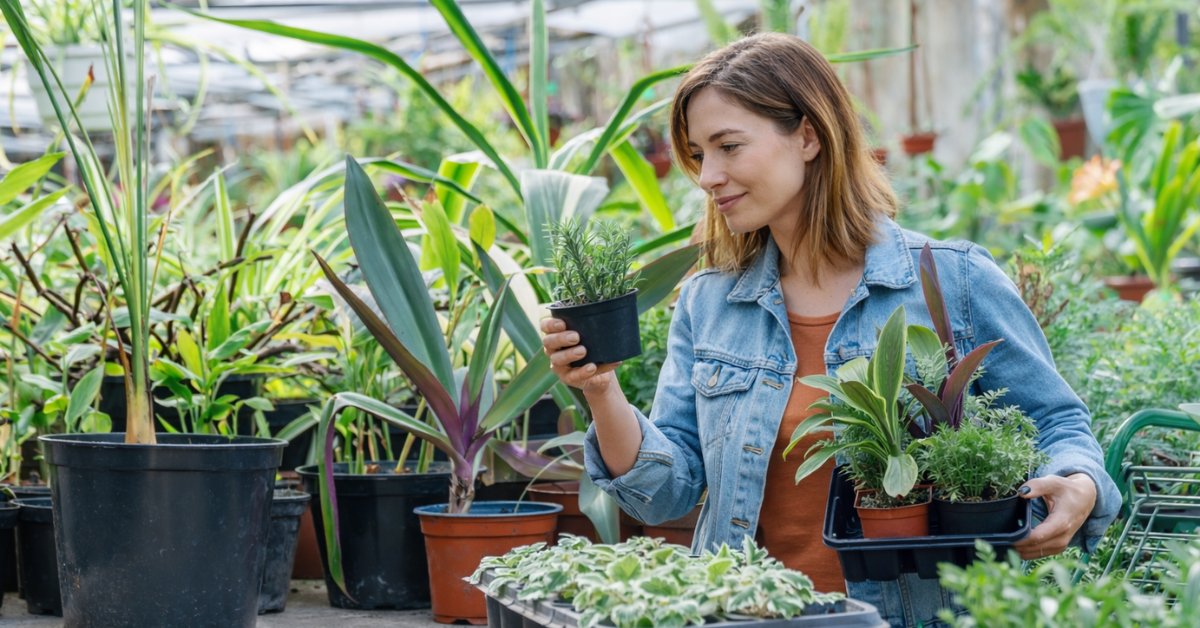
Buying a potted plant or container plant may seem trivial… and yet, that’s often where everything hinges. A plant poorly chosen at the garden center can wither in a few weeks despite all your care. If you want it to thrive sustainably in your home or garden, it’s best to check a few essential points before you head to the checkout.
Foliage, roots, pot, substrate… Here’s how to spot a truly healthy plant — and avoid nasty surprises.
Buying a potted plant: how to choose the right one
Before buying a potted plant, it’s essential to verify that it is in good health and that it sits in a container suited to its size. This simple habit can make all the difference between a plant that thrives… and a plant that declines quickly.
Inspect the plant: is it really healthy?
When you’re about to purchase a new potted plant, take the time to observe its foliage. It should be dense, uniform, and free of suspicious spots, which are often signs of disease or nutrient deficiencies.
Also be attentive to pests. Invisible at first glance, they usually hide under the leaves. Don’t hesitate to lift them to inspect their undersides.
Also look at the main stem: it should be firm and intact. A weakened stem undermines the plant’s growth.
Finally, gently press the pot to loosen the root ball. This helps check the root condition. They should be light-colored, firm, and odorless. Black or mushy roots are a very bad sign.
Mind the pot size: a common trap
When you choose a plant, be mindful of the size of its pot. A plant that’s well developed in a small container may look attractive… but it’s often a bad sign.
It’s probably received a lot of fertilizer to speed up growth. Result: an artificially boosted plant, but fragile once it leaves the nursery.

Conversely, always prefer a plant that is proportioned to its pot. It’s a sign of more natural development and a better ability to adapt.
Inspect the roots: the detail that changes everything
Roots are often overlooked… and yet they are decisive.
If they distort the pot or pour out through the drainage holes, it means the plant has been cramped for too long. It’s likely to struggle after planting.
On the flip side, a few visible small roots is a good sign. It indicates healthy, balanced growth.
Extra tip: don’t repot right away
Once you’re home, avoid repotting your plant in a rush. It’s already endured stress (transport, a new environment).
Let it acclimate for a few days in a bright spot, away from direct sun. This simple step greatly increases its chances of getting established.
Natural tip: boost your plant without chemical fertilizers
To support recovery, there’s no need to use chemical products.
You can water your plant with:
- Chilled cooking water from vegetables (no salt)
- Or the rinse water from rice
These mineral-rich waters naturally stimulate growth.
A choice that also has an ecological impact
Behind some potted plants lie intensive farming: heated greenhouses, long-distance transport, and use of chemical inputs…
Choosing local producers or short supply chains not only reduces environmental impact, but also often yields plants that are better adapted to your climate.