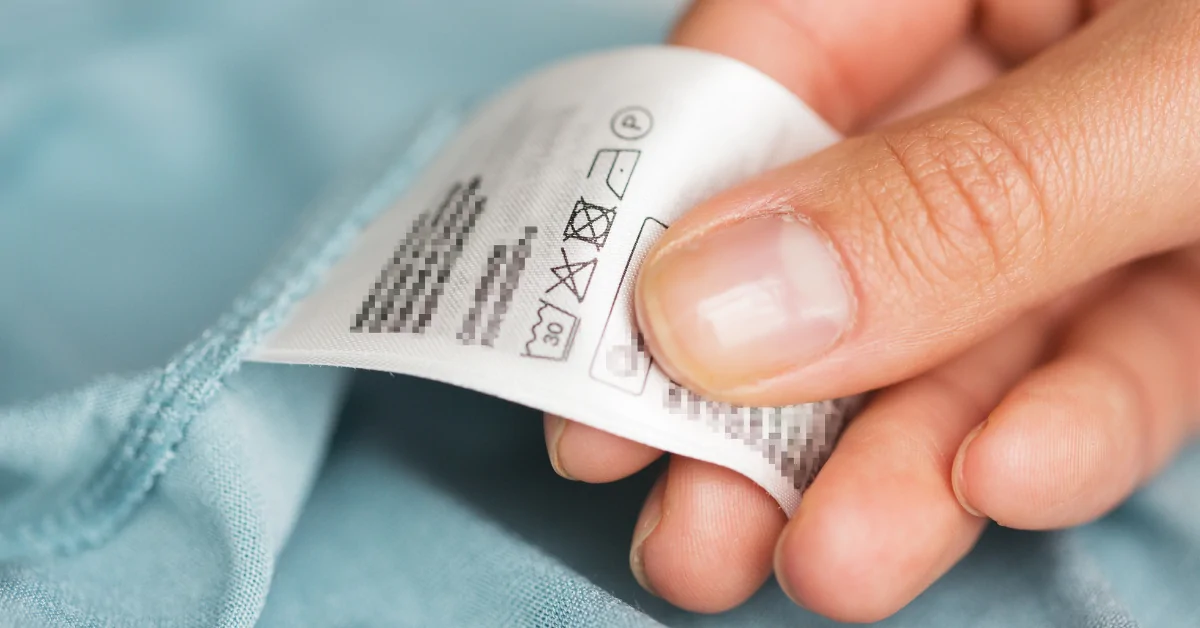
Buying a garment is often driven by a need or a fashion impulse during a shopping spree. Before heading to the checkout, people don’t always think to read the textile label sewn into the garment, and they don’t always realize how to take care of it.
We’ve all heard the joke: standing in front of the washing machine, when sorting laundry, the symbols on the label can look like true hieroglyphs, indecipherable! To help you make sense of clothing labels, consoGlobe.com offers a Quick Guide to the symbols.
Textile labels: mandatory in France
The first thing to know about the labels on garments is that they are mandatory in France. While some symbols are optional, every garment in France must indicate:
- the product composition,
- the percentage of each textile fiber used in the item offered for sale.
Moreover, it is illegal to mislead customers with false or deceptive label information.
Thus, customers must be able to read the product’s fiber composition label before buying, to be fully informed about the fibers used in the product they have chosen.
Furthermore, in France, while the composition must clearly appear on the labels, care labeling is not mandatory. However, care labeling is very often placed alongside the composition to help the customer best preserve the garment.
Regarding care symbols, they are governed by a strict regulation established by the ISO 3758 standard. This standard was determined by the French Committee for Textile Care Labeling (COFREET) at the French level, and by the International Group for Textile Care Labeling (GINETEX) at the international level.
Each symbol is registered with the World Intellectual Property Organization (or WIPO) and follows a specific order:
- washing,
- bleaching,
- drying,
- ironing
- dry cleaning
First care instruction on textile labels: washing
All washing instructions are indicated using the basin symbol — a small tub filled with water. The symbols may indicate fabric sensitivity, the ideal washing temperature, and any special treatment a garment may require.
 Relatively rare, this first symbol indicates to the consumer that washing is not allowed. This can apply to water-sensitive items or pieces that cannot be laundered by conventional means due to size.
 This symbol targets the most delicate items. The hand wash should be done with water at a maximum of 30–40 degrees Celsius after the detergent has been dissolved. Items washed with this method must not be rubbed, wrung, or twisted. Each item should be washed promptly and not pre-soaked.
 This symbol commonly concerns cotton or polyester items. It indicates that the garments can withstand a washing at 30 degrees.
 Like the previous symbol, this pictogram indicates that the garments can be washed at 30 degrees, but the bar beneath the basin indicates that garments washed this way should ideally not go through an spin cycle to avoid creasing. This mainly concerns viscose, polyamide, and modal fabrics.
 This pictogram often applies to wool items, which should be washed in small loads at 30 degrees.
 The tub with the number 40 typically relates to colored fabrics, cotton and polyester.
 This symbol concerns multicolored, more delicate items that must not be wrung. In this case, the prewash cycle should be used only for very dirty clothes.
 This pictogram concerns wool items that can be washed at 40 degrees. Ideally, to protect the fabric and avoid damage, it is recommended to fill the washing machine to only a quarter to one third.
 This symbol concerns colored items, often cotton, modal or polyester, that do not tolerate high temperatures.
 This new symbol relates to items labeled as easy-care. Still, some precautions apply: do not wring the fabric or fill the machine completely.
 This symbol applies to items that tolerate high temperatures, such as linen or cotton.
 This symbol is often shown on so‑called “easy-care” items. However, wringing them can cause creasing, and it’s important not to fill the machine completely.
Bleaching symbols on textile labels
There are only three bleaching symbols, all represented by a triangle.
 The white triangle indicates that bleaching is allowed, whether chlorine or oxygen bleach is used.
 The striped triangle indicates that the product tolerates only oxygen bleaching.
 The barred triangle indicates the product does not withstand any bleaching. It is therefore important to check that your detergent does not contain bleaching agents (often oxygen-based).
Machine drying: beware of shrinking!
Machine drying is represented by three symbols, depicting a circle inside a square. The circle may contain several “dots” that indicate the maximum drying temperature the fabric can handle. Some items are more sensitive to drying, such as wool, drapes, or cotton knits that can felt, crease, or shrink.
 This symbol indicates the fabric may be tumble-dried normally, with no restrictions.
 This symbol indicates that garments may be tumble-dried, but at reduced temperatures and with gentler mechanical action.
 This symbol forbids any machine drying. The alternative is to hang the garment on a hanger and air-dry it!
Ironing: temperature safety
Just like washing and drying, ironing follows temperature guidelines to avoid permanently damaging a garment. Ironing symbols are shown with an iron icon, and dots indicating the heat tolerance of the item.
 This symbol with three dots is commonly recommended for products made of cotton or linen. To use this temperature, it’s advised to work with the fabric still slightly damp. A steam iron can be used for this type of fabric.
 This symbol indicates ironing at a medium temperature, often recommended for wool, silk, or viscose. Avoid pressing too hard to prevent distortion, and consider placing a damp cloth between the item and the iron. A steam iron can be used.
 This pictogram indicates ironing at a low temperature. This applies to sensitive fabrics such as acetate, nylon, or acrylic. It’s best to iron inside out. Using a steam iron can distort the items.
 This symbol excludes any ironing.
Professional cleaning: dry or wet
On garment labels you’ll also find instructions for professionals. Laundries can thus know which solvent they should use… Often not very eco-friendly!
Dry cleaning
This type of cleaning is represented by a circle containing a capital letter.
 This symbol shows that the professional may use perchloroethylene or hydrocarbons to clean the item. If a stain remover is needed, it’s best to test it on the product first.
 This symbol concerns items that can be dry-cleaned with perchloroethylene or hydrocarbons, but with a limitation on water addition, temperature, and mechanical action.
 This symbol indicates that dry cleaning should only be done with hydrocarbons, with no solvent-based stain removers.
 Clothes bearing this symbol must be dry-cleaned with hydrocarbons, with limited mechanical action, temperature, or water additions. Solvent-based stain removers are not allowed.
- This symbol excludes dry cleaning.
Wet cleaning
This professional wet cleaning is also represented by a circle with a capital letter inside. The use of this symbol is rarer and serves as a complement to dry cleaning: the goal is to achieve a better result for the garment than with standard domestic cleaning.
 This symbol indicates that the item can be very clearly cleaned with professional water cleaning, without any restrictions.
 This symbol requires that the garment be cleaned with reduced mechanical action to respect delicate fabrics.
 Garments bearing this symbol support Aqua-cleaning, but with reduced mechanical treatment.
 This pictogram indicates that professional wet cleaning is not recommended.
Lire correctement les étiquettes d’un vêtement peut parfois s’apparenter au parcours du combattant, mais c’est un passage obligé pour pouvoir conserver correctement ses vêtements. Un produit mal étiqueté suggère une mauvaise qualité ou une provenance inconnue.
Pour protéger la nature avec votre linge, vous pouvez opter pour un lavage avec des boules de lavage et ainsi en finir avec les lessives classiques. D’autre part, de plus en plus de vêtements bio sont également présents sur le marché.
Article updated