
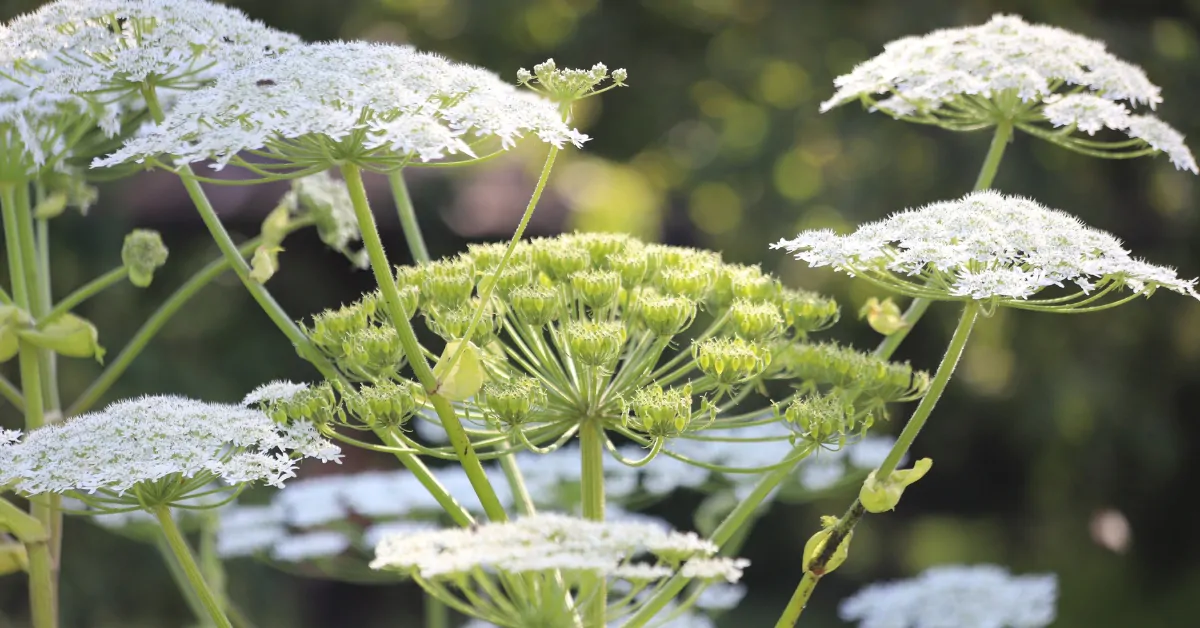
This giant plant, spectacular in its size, sometimes piques the curiosity of gardeners. Yet it ranks among the most problematic plant species because of its rapid spreading and the health risks it poses to humans. In France, its introduction and dissemination are strictly regulated by law. In the United States, regulators at federal and state levels treat this plant as a potential invasive, with controls that aim to prevent its introduction, possession, transport, or release into the environment where it could cause harm.
How to recognize Sosnowsky’s hogweed, this giant, invasive plant?
Sosnowsky’s hogweed (Heracleum sosnowskyi) belongs to the Apiaceae family, the same family as carrot, fennel, and parsley. Native to the Caucasus, it was widely cultivated in several regions of the Soviet Union from the mid-20th century as a forage plant because of its exceptional growth.
Its main distinguishing feature lies in its imposing size. This plant can reach between 3 and 5 meters in height (about 9.8 to 16.4 feet). Its hollow stem, often speckled with purple, can exceed 10 centimeters in diameter (about 4 inches). Its deeply dissected leaves can sometimes exceed a meter in length.
The flowering stage is also a key identification element. The plant produces broad white umbels up to 80 centimeters in diameter (roughly 31 inches). From a distance, it can resemble common hogweed, a native species far less majestic, or the well-known Caucasian hogweed. This resemblance can complicate field identification.
Each individual is capable of producing tens of thousands of seeds. This characteristic explains its remarkable ability to colonize road verges, wastelands, embankments, or certain wetlands. Once established, it quickly forms dense stands that suppress the development of many local plant species.
Sosnowsky’s hogweed, a plant dangerous to health
The concern about this plant goes beyond its invasiveness. Its sap contains photosensitizing substances called furanocoumarins. When this sap comes into contact with the skin and is then exposed to ultraviolet rays from the sun, it can cause burns that are sometimes severe. Health authorities in Russia as well as several organizations specializing in invasive species regularly report lesions comparable to second-degree burns.
The risk is particularly high during hot, sunny periods. Symptoms do not always appear immediately. Redness, blisters, and heightened skin sensitivity can manifest several hours after exposure. This danger explains why botanists recommend avoiding any handling without proper protective gear. Children are especially vulnerable, as the plant can be perceived as harmless due to its spectacular appearance.
Beyond health consequences, Sosnowsky’s hogweed profoundly alters the ecosystems it colonizes. By monopolizing space and light, it reduces local plant diversity and disrupts existing ecological balances. Under the official definitions of invasive alien species used by government agencies, an invasive species is precisely a non-native species whose spread causes ecological, economic, or health impacts.
How present is Sosnowsky’s hogweed in France?
Sosnowsky’s hogweed remains far less widespread in France than some other well-known invasive plants such as Japanese knotweed or pampas grass. Nevertheless, several specialists in invasive flora consider its establishment worthy of careful monitoring. International horticultural exchanges have facilitated the introduction of many exotic species in recent decades. Some of them later found conditions favorable to their development.
The confusion with Caucasian hogweed sometimes complicates monitoring. The two species share highly similar morphological features and comparable health effects. In both cases, managers of natural spaces monitor their progress to prevent a durable establishment in sensitive environments.
Climate change could also favor the expansion of certain invasive exotic species into areas where they were previously scarce. Biodiversity specialists now view invasive species as one of the primary threats facing European natural ecosystems.
Sosnowsky’s hogweed: what penalties does French law provide?
In France, regulation concerning invasive alien species relies on several national and European texts. The 2014 European Regulation on invasive alien species prohibits the introduction, possession, transport, commercialization, or dissemination of the species concerned in the environment. These measures aim to limit impacts on biodiversity, economic activities, and public health.
The 2016 French Biodiversity Law reinforced this framework. Articles L.411-5 and L.411-6 of the Environmental Code provide various prohibitions concerning certain invasive plant species. According to the services of the Ministry for Ecological Transition and several regional environmental authorities, it can be illegal to introduce a species into the natural environment, and also to possess, transport, exchange, or sell it.
Penalties can be particularly severe for violations. Offenses relating to invasive alien species can be punished by up to three years in prison and fines up to 150,000 euros under the most serious cases provided by the Environmental Code.
For amateur gardeners, the authorities’ message is clear: before introducing a relatively uncommon plant into a garden, it is essential to check its regulatory status. A plant that is spectacular ornamentally can sometimes become a real ecological, health, and legal problem.