
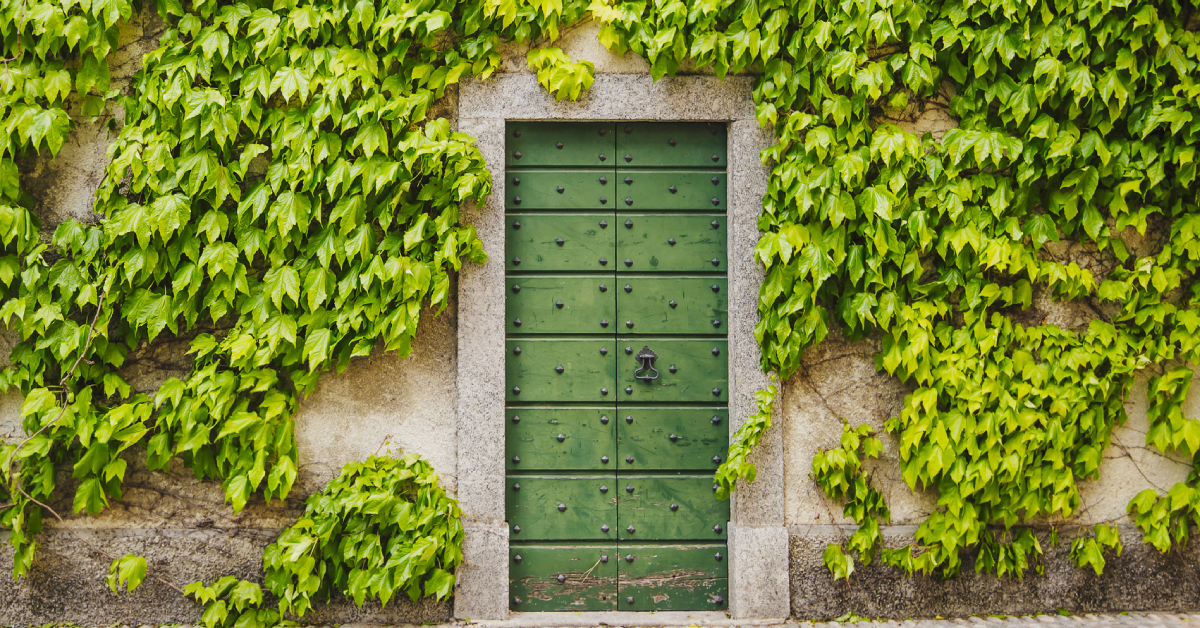
Ivy remains a misunderstood plant that people believe is an invading parasite that devours everything in its path. The reality is far from this horror scenario, and we are seeing more and more actions and designs that give it pride… Rightfully so!
Ivy for better temperature control
Ivy (Hedera helix) is a hardy plant that can cover an entire house as securely as trees do in the wild.
Its evergreen foliage, resembling a living wall, helps to limit rising temperatures inside the home, as it is estimated to absorb 28% of radiant heat on a hot summer day. And the evapotranspiration of its leaves (water loss due to heat) also lowers outdoor temperatures.
Meanwhile, once ivy is established, its sturdy leaves, often numerous and at multiple depths, also play a wind-buffering role and thus help cool the home.
Finally, whatever support you choose to train your ivy on, know that it will shield it from UV rays as well as weather, giving it longer durability over time. And it will also protect your wall from… graffiti!
Biodiversity in ivy?
In nature, ivy growing on tree trunks stops at the canopy level, thus creating no competition between it and the host plant, unless the latter is weakened or diseased. It certainly won’t be the same with your house, but this mainly tells us that ivy is not a parasite; otherwise it would overrun the entire tree.
Far from it in reality. It shelters an enormous number of animals of all sizes, up to the tawny owl if it becomes large enough! Butterflies, blackbirds, squirrels and many other animals will find shelter, breeding sites, or food there.
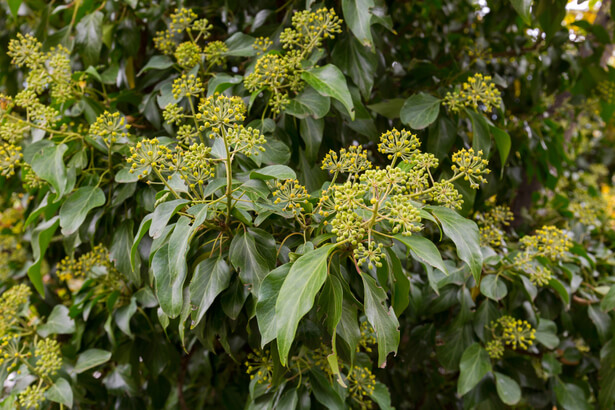
To fulfill its role as an incredible biodiversity booster, ivy is one of the rare plants whose flowering is so late in the year (late September to late October, sometimes November), providing nectar for pollinators when there is little else to eat.
The fruits then form in February, which is also very rare, allowing many birds to find something to eat during a difficult moment of the off-season.
Caring for Ivy
Ivy is a hardy plant; once established around your home, it will hardly need your help. More importantly, its upkeep doesn’t require gloves in the literal sense.
Prune it once or twice a year in spring depending on its vigor and take the time to watch how it grows. Ivy, like most plants, will certainly seek maximum light. Based on this observation and by carefully watching yours, prune it to properly channel it and give it the orientation you want.
In terms of watering, rain is enough, but applying mulch can help it grow faster and better resist drought. If it’s really lacking vigor, you can also top-dress with manure under the mulch in spring.
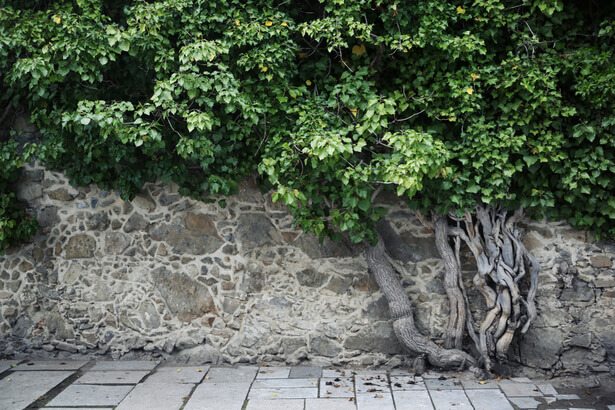
The ivy clings to a wide range of surfaces using its suction cups. We often think it damages a wall, but that isn’t the case; it’s just hard to clean. Since ivy protects the walls, perhaps it’s smart to let it grow on your facade rather than invest in a new stucco or paint…
Taming Ivy with Supports
To ensure your ivy grows well without letting it latch onto your walls, there are trellises.
Wood Trellises
They last longer and give a natural look. Their varied geometric patterns contribute to the design.
By keeping the wood trellis a bit away from the façade, a breeze can flow between the two, creating air circulation and increasing the trellis’s longevity.
Metal Trellises
Made from corrosion-resistant metals, they last longer. It’s wise to choose light-colored materials to prevent the structure from becoming too hot.
Cords
They provide very good grip, are easy to use, inexpensive, aesthetically pleasing, but have a short lifespan.
Cables and steel wires
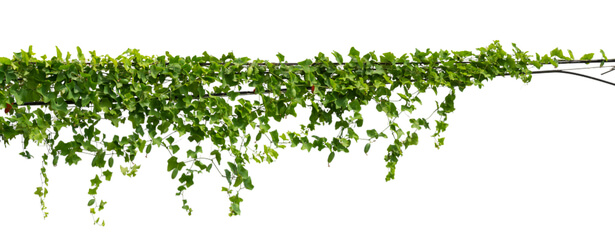
This type of cable lets you shape all of your ivy, especially if you want a particular form. They enable you to imagine a very tall structure thanks to their strength.
How to get rid of ivy
Cleaning your façades or any surface ivy has grown on is not easy if you don’t approach it correctly.
If you want to get rid of your ivy, it’s not too hard. First, cut the base of the plant and immediately (some ivy can survive for years even after the base is cut) pull it down from the top to ground level, and cut all the sections from the largest to the smallest.
If the ivy is really old, you can tarp it to ensure the effectiveness of the process. In general it isn’t too hard to finish, but stay vigilant by cutting any possible new shoots.