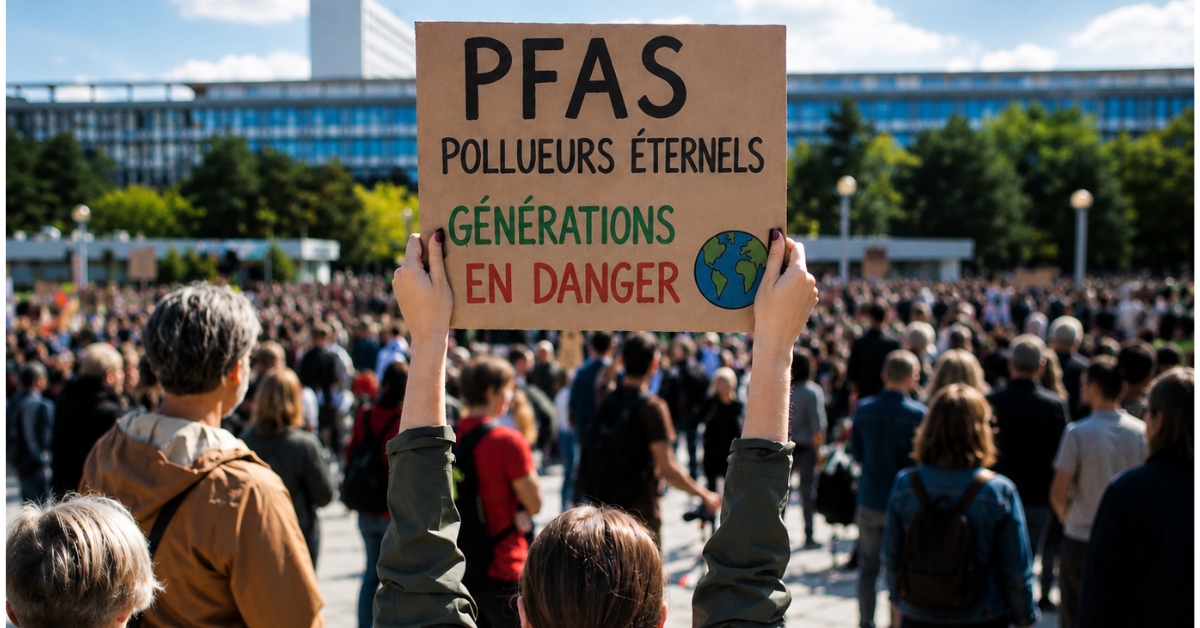
Their aim is to force the French state to act at last against a massive contamination that silently poisons the environment and the bodies of millions of citizens.
A Widespread Contamination with Dramatic Consequences
Per- and polyfluoroalkyl substances, better known by the acronym PFAS, are among the most insidious pollutants of our era. Massively introduced into the chemical industry starting in the 1950s, these molecules accumulate relentlessly in the air, soils, waterways, and, at the end of the chain, in our own tissues. Their nickname “forever pollutants” says it all about their nature: virtually indestructible in the environment, they persist for decades, sometimes centuries, creating a toxic debt that we pass on to future generations.
Found in cosmetics, nonstick cookware, waterproof clothing, and food packaging, they infiltrate a daily life we once thought ordinary. Yet the health consequences are severe: some PFAS are now linked to cancers, fertility problems, liver damage, and immune system dysfunction. A reality all the more alarming given that the Forever Pollution Project had already exposed the dizzying scale of Europe’s contamination.
The French People Are Particularly Exposed, According to the Latest Data
The situation in France is especially troubling when measured against European peers. A report published in October 2025 by the Haut Commissariat au Plan on environmental health policies reveals striking figures: 24% of French adolescents have serum PFAS concentrations above the European Food Safety Authority (EFSA) recommendations — compared with 18% in Germany and just 1% in Spain. These disparities directly call into question the effectiveness of France’s public health policies.
Several French regions also rank among Europe’s contamination hot spots. The “chemistry valley” south of Lyon, the environs of the Tefal plant in Rumilly in Haute-Savoie, and certain areas of Haut-Rhin are all sites where pollution levels reached thresholds that forced local authorities to prohibit drinking water or the consumption of locally grown vegetables in some cases.
Fifteen Years of Neglected Scientific Warnings
Critics accuse the state of “inaction,” pointing to a relentless timeline of warnings ignored. As far back as 2008, parliamentary reports explicitly cited PFAS risks and documented territory-wide contamination. François Veillerette, spokesperson for Générations Futures, denounces “a double failure, past due to inaction and present due to insufficient action.”
The plaintiffs have meticulously reconstructed this sequence of ignored alerts. Over the years, the French Agency for Health Security (Anses), the Geological and Mining Research Bureau (BRGM), Santé publique France, and the National Institute for the Management of Industrial Risks (Ineris) repeatedly identified the troubling presence of substances such as PFOA, classified as “carcinogenic to humans.” “The early hot spots, like the chemistry valley of Lyon, were explicitly identified, yet it was only ten years later that local residents would begin to learn of the scandal,” complain the associations in their complaint filed with the Paris administrative court.
An Insufficient Law, Implemented Too Late
Although a law intended to protect the population from PFAS was finally enacted in February 2025, associations deem the text seriously inadequate to the stakes and criticize the delays in its implementation. The legislation calls for a 70% reduction in industrial discharges of “forever chemicals” into French waters by 2028, as well as the ban on certain uses in clothing, cosmetics, and ski waxes starting January 1, 2026.
However, one of the most anticipated provisions — a pollution levy based on the polluter-pays principle — has still not been implemented. More than a year after the law’s enactment, the government decided in spring 2026 to push back by six months the publication of implementing decrees for this measure, which is crucial to funding the cleanup of contaminated areas. In the view of the plaintiffs, this delay illustrates a policy that continues to privilege economic interests over public health.
Damages Sought for Anxiety-Related Harm
Beyond the call to act, the lawsuit also seeks recognition of the harm suffered by exposed populations. The six individuals attached to the action, from Haut-Rhin and Haute-Savoie, are seeking €10,000 in damages each for “anxiety harm,” plus an additional €1,000 for moral damages. Symbolic in amount, this claim is meant primarily to set a legal precedent: to acknowledge that exposure to forever chemicals causes legitimate psychological distress—the burden of living in constant uncertainty about the health effects of a contamination they did not choose to endure.
The associations also demand that the state organize “the management of environmental and health costs” linked to this pollution. According to estimates from the Forever Pollution Project, these costs could range from €14.3 billion to €245.3 billion over twenty years for environmental impacts alone, with an additional €39 to €54 billion in health costs projected through 2050.
A Growing International Mobilization
This French legal action sits within an international movement resisting PFAS. A week before the case was brought to court, the United Nations Human Rights Council named five special rapporteurs to assess the French authorities’ response to the pollution observed in the Lyon chemistry valley — a sign that the international community is now watching how Paris handles this issue.
The cross-border nature of forever chemicals and their environmental persistence call for unprecedented coordination across all levels of governance, from local to global. The outcome of this process could forge a landmark jurisprudence not only for France but for all countries grappling with this mass contamination — and raise, more fundamentally, questions about states’ ability to translate scientific data into public policy in the face of industrial interests.
“This action should enable a real public debate about the state’s role in facing pollution,” hopes Jérémie Suissa, general secretary of Our Case to All. A debate all the more urgent as chemical compounds know neither borders nor prescription deadlines.