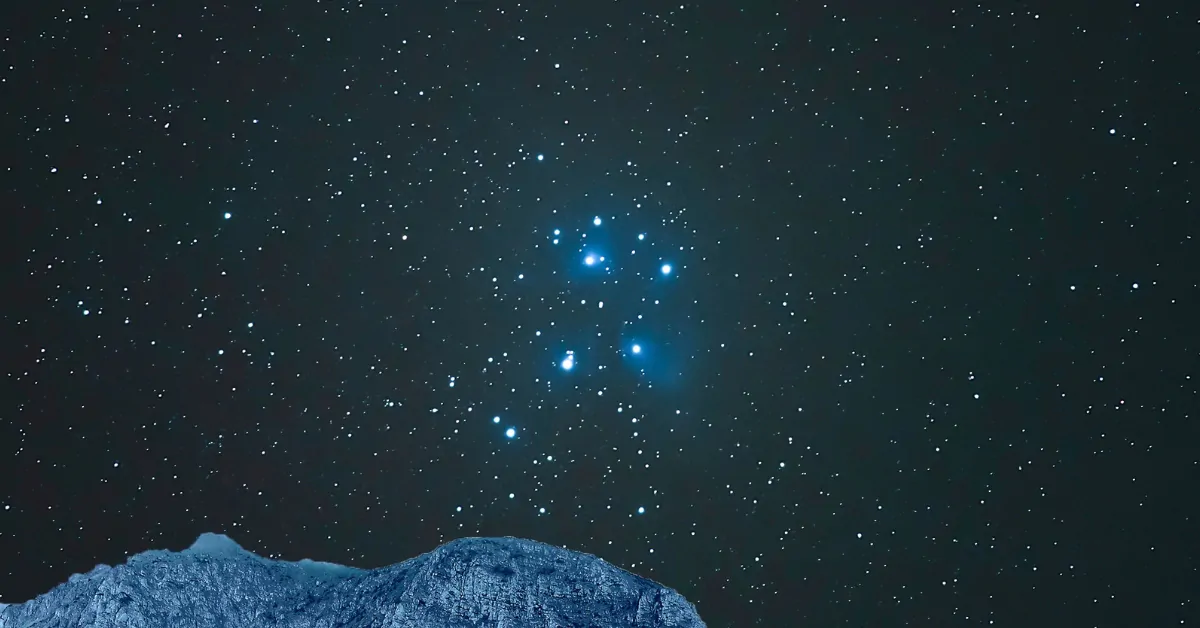
No telescope is needed to embark on a night of discovery of the Pleiades tonight. Also known as the Seven Sisters, this small, easily recognizable cluster is gradually reappearing in the late-summer night sky. From Paris, the Pleiades become easily observable starting around 12:30 a.m., looking toward the northeast. They rise higher in the sky as the night goes on: waiting a few hours allows you to observe them under better conditions, up to the first faint light of dawn.
A Moon–Pleiades Conjunction
The night of September 2–3 features a peculiarity: the Moon lies in apparent proximity to the Pleiades in the Taurus constellation. The closest approach between the two bodies occurs on September 3, with a separation of about 1.2 degrees. From France, the closest alignment takes place during daylight. But during the night, the Moon still provides a good reference point for locating the region of the sky where the Pleiades lie.
It also has one drawback: it remains clearly illuminated — its phase goes from about 74% on September 2 to 63% on September 3 — it makes the sky brighter and can wash out the fainter stars in the cluster.
How to recognize the Pleiades?
With the naked eye, the Pleiades look like a small, tight handful of stars, sometimes compared to a miniature Big Dipper. They lie about 445 light-years from Earth, in the Taurus constellation. The cluster contains more than a thousand stars, but only a few dominate visually, hence its traditional nickname of the “Seven Sisters”. With a bit of practice, their compact shape makes them fairly easy to distinguish from the rest of the sky.
Do you need binoculars to observe them?
No, since M45 is visible to the naked eye as soon as the sky is sufficiently clear. A pair of binoculars, however, is ideal. They reveal many more stars while keeping the entire cluster within the field of view. A highly magnified telescope is paradoxically less well suited, because the Pleiades occupy a relatively broad swath of sky.
To maximize your odds tonight, it’s best to get away from streetlights, pick a clear northeastern horizon, and give your eyes about fifteen minutes to adjust to the darkness.
And if the Moon interferes too much, there’s always another night: the Pleiades will become increasingly easy to observe throughout autumn, before offering their best evening viewing conditions during the winter months.
Also read
When light pollution erases the dark night sky