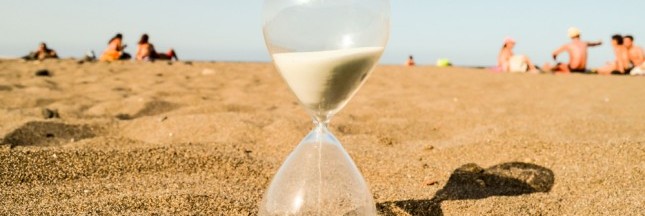
Sand evokes most often the beach, holidays, and tropical paradises. Yet, our relationship with sand goes far beyond the two or three weeks of summer vacation. Sand is part of our daily lives; it is almost omnipresent. And yet this essential resource is running out. It is the victim of a colossal, ever more voracious industry, driven by plunder.
Is Sand Running Low Soon?
A few people realize it, but sand ranks third among the most-used resources, after air and water, but ahead of oil or coal!
It supports around 200 everyday uses, ranging from water filtration to the manufacture of microchips and high-tech products, not to mention glass, which is one of its main uses.
Beside these obvious domains, sand also hides in much more unexpected products: because it is a source of silicon dioxide, it is found in wine, paper, toothpaste, and thousands of other items.
Sand is also used to build airplanes because it goes into the plastic of engines, paint, and even tires. In other words, in today’s society, sand has become like air or water: we cannot live without it.
Construction: A Major Sand Consumer
Where sand is vital is in the construction sector. In aggregates (mineral grains ranging from sand to gravel), sand forms the raw material for concrete found in almost every type of structure. It’s estimated that the current real estate boom drives demand for about 2 tons of concrete per person per year!
Because its production cost is relatively low and it offers unbeatable properties, reinforced concrete is the dominant building material on a global scale. Yet it is composed of two-thirds aggregates and one-third cement and water… So sand is present in two-thirds of the world’s buildings.
Beyond construction, the public sector also loves sand, as it is needed to build roads, for instance.
Sand Extraction Triggers Imbalances
Yet sand is a non-renewable resource. For years, sand came from quarries that were running dry. Faced with this reality and the need to source this resource, the decision was made to drill from riverbeds.
But that had two catastrophic environmental consequences: first, sand extraction triggers floods; second, when we draw sand from rivers, we prevent the natural replenishment of beaches.
Indeed, the sand on beaches comes from rocks located sometimes thousands of kilometers away. It is carried by rivers and it takes a century to a millennium before it reaches seas and oceans.
While sand mines and quarries are drying up worldwide, the last place to find sand is at the bottom of the sea. To extract sand from the ocean depths, huge specialized ships come into play, capable of extracting and hauling up to 400,000 m³ of sand per day. This plundering of seabed sands has grave environmental consequences.
The Overexploitation of Sand: Ecological Catastrophe, Economic Opportunity
When dredges pump sand from the bottom, they swallow a material that took tens of thousands, even hundreds of thousands of years to form.
Biodiversity in Danger
The harvesting of seabed sands represents a catastrophe for all living organisms. The destruction of the natural habitat of bottom-dwelling creatures leads to their disappearance, which affects all the levels above them. All fish die due to a lack of food: it is thus the survival of all species that depends on sand.
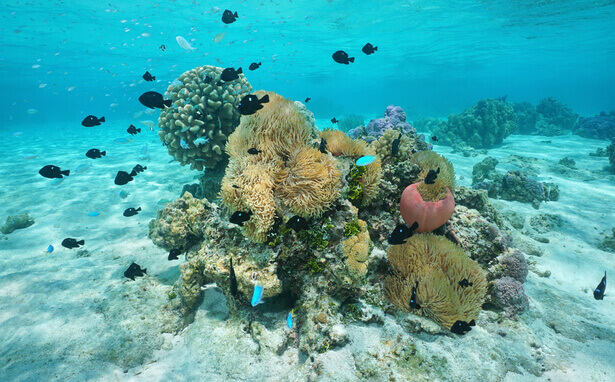
The biodiversity is threatened, with direct consequences for humans. In Indonesia, for example, many families rely on fishing for their livelihood. There, 92% of the fish consumed comes from small-scale fisheries. With the destruction of seabed habitats, resources for thousands of families are wiped out as well.
Indonesia bears the cost of its neighbor Singapore’s appetite. The city-state expanded by 130 square kilometers over the sea in the past forty years, purchasing billions of tons of sand from Indonesia with irreversible consequences for the region. As a result, 25 islands of the Indonesian archipelago have simply disappeared from the map due to Singapore’s sand predation.
By pumping sand from the sea with reckless abandon, the natural balance is disrupted. The vacuum created by sand removal is quickly filled by the wind and waves, causing beach and nearby island sand to fill these giant holes. This global phenomenon leads to beach erosion: 75 to 90% of the world’s beaches are retreating, with an accelerating trend.
In Florida, for example, 9 out of 10 beaches are on the verge of disappearing. Sometimes entire islands vanish. These practices also threaten nearby infrastructure, with bridges sometimes collapsing as a result of dredging activity.
Another collateral victim: agriculture. With the disappearance of sand, seawater seeps into groundwater and prevents the cultivation of arable land.
The Sand Demand Frenzy: The New Yellow Gold
A massive market, the aggregate industry is thriving. And for good reason: we will always need to build buildings and roads. Sand demand continues to grow. According to UNEP, this trade is expected to rise by 5.5% per year with urbanization and infrastructure development. But sometimes, it is to satisfy the most extravagant whims!
Dubai and Its Extravagances
Dubai is famous for its architectural extravagances: bigger, taller, more expensive, Dubai imposes no limits on construction. Not even the sea. In the early 2000s, the emirate embarked on the mania of the “Palm Islands.” Because speculation makes artificial islands cheaper than buying land, Dubai invested over $12 billion and consumed 150 million tonnes of sand to build its archipelago.
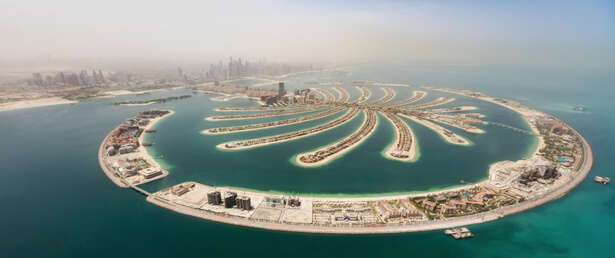
Insatiable, Dubai launched in 2003 on a quest for world domination through its other grand project, “The World,” a cluster of 300 artificial islands laid out like the world map. The result: $14 billion and more than 500 million tonnes of sand consumed for a project that abruptly halted in 2008 due to the financial crisis.
Sand at the Heart of International Trade
One might assume that all the sand used comes from nearby deserts. In fact, that’s not the case. It is impossible to construct an artificial island with desert sand.
There are, indeed, different kinds of sands. Depending on their origin, they have different properties. For instance, desert sands are very round and smooth due to wind action, which makes them unsuitable for construction where angular grains are needed for clumping. Hence the use and overexploitation of marine sand for construction, which is far from a sustainable resource.
With the UAE largely out of stock, they are now forced to import sand. This was the case for Dubai, which imported 45,700 tons of sand from Australia to build the Burj Khalifa, the tallest tower in the world. Sand exports to Middle Eastern countries bring Australia about $5 billion per year.
China, the World’s Top Sand Consumer
China uses 60% of the world’s sand production on its own. Proof of the scale of its real estate boom: in recent years, its consumption has equaled the amount measured in the United States during the 20th century.
In general, the sand industry is worth billions of dollars. The market is so huge that it’s tainted by a genuine mafia-like network.
Sand, a Resource Victimized by Trafficking
When a resource is overexploited, scarcity and rising prices follow. This bidding war has given rise to a sand mafia, particularly active in Asia.
The Sand Mafia
The Asian continent is living through a vertiginous construction boom. Demand for sand is so intense that it has given rise to a massive trafficking network.
Thus, in India, the sand mafia is exceptionally powerful. It controls the entire construction sector. Each year, 2 billion tonnes of sand are illegally mined in the country to feed the real estate boom—more than five times France’s consumption.
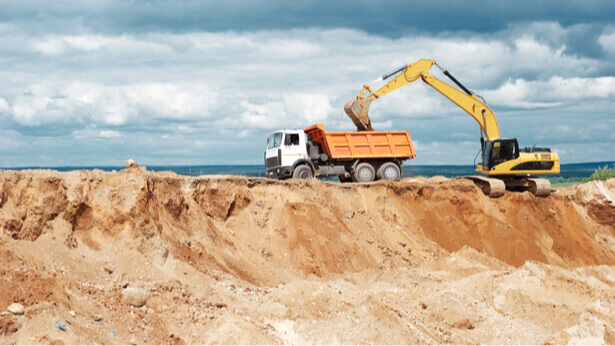
Singapore, which remains insatiable, imports sand illegally from neighboring countries such as Cambodia, Vietnam, Malaysia, and Indonesia. These nations, aware of the catastrophic impact of beach sand mining, have officially halted exchanges. Yet Singapore continues its trafficking via dealers and shell companies, with state complicity.
Of course, this phenomenon is not limited to Asian borders. The problem is global: sand mafias plunder sand everywhere. Sand pillaging affects countries across all continents.
In Morocco, for example, demand for construction is booming. The country has become a retirement paradise and a long-time destination for vacationers. And there is a need to house this influx. Today, it is estimated that the mafia controls 45% of the sand on Moroccan and Senegalese beaches. Moreover, this sand is often poorly washed, leaving sodium present in seawater, which makes buildings vulnerable to corrosion.
Protecting Sand
Exploitation of resources triggers political or private actions. We see this with water, for example, though the path remains long. By contrast, the sand question rarely reaches the top agendas of the highest authorities. Yet, it is urgent to change our construction methods to do without sand.
There are already alternatives: straw, earth, wood, recycled materials (including concrete), ash from incineration… It has even been discovered that glass can be recycled into sand. This option would be particularly valuable for construction, especially since ¼ of discarded glass is never recycled.
When the sand and sustainability report (Sand and sustainability: Finding new solutions for environmental governance of global sand resources) was released in May 2019, Joyce Msuya, Interim Executive Director of UN Environment, stated: “We are spending our sand budget faster than we can responsibly produce it. By improving governance of global sand resources, we can better manage this essential resource in a sustainable way and show that infrastructure and nature can go hand in hand” (1).
Illustration banner: hourglass in the sand – © underworld
Article republished
- https://www.unenvironment.org/fr/actualites-et-recits/communiqué-de-presse/laugmentation-de-la-demande-de-sable-appelle-la