
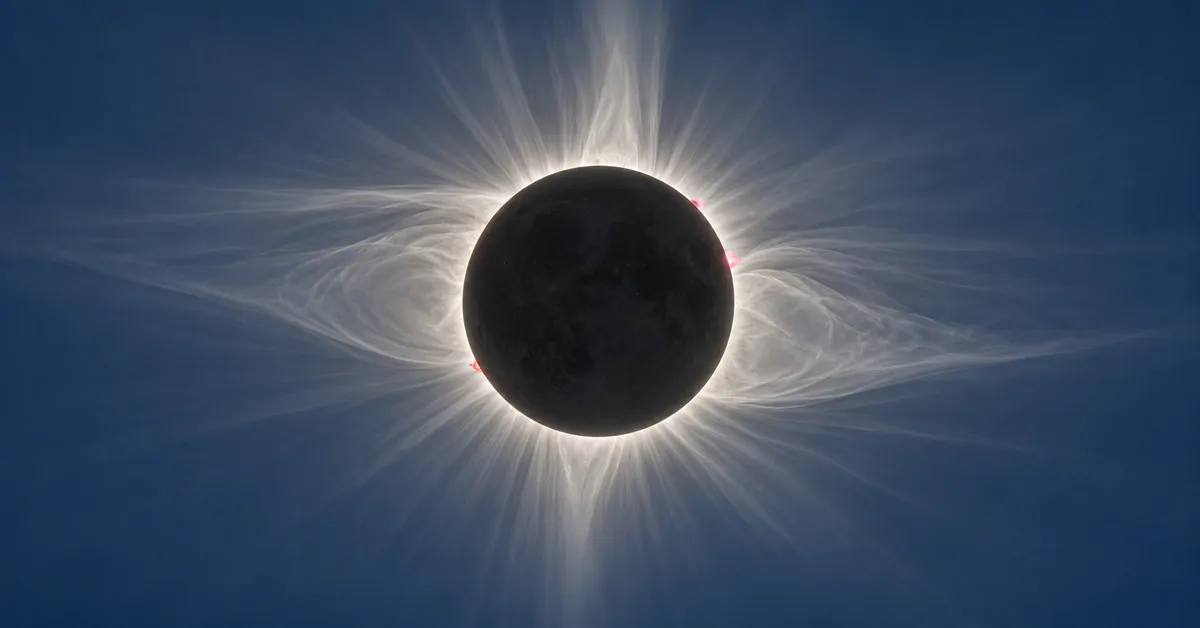
The Egyptian sky is set to present an extraordinary spectacle. On August 2, 2027, in the early afternoon, the Moon will completely cover the Sun for several minutes. Daylight will fade, giving way to an eerie twilight, as the Sun’s corona becomes visible around the Moon’s dark disk.
A Solar Eclipse of Unprecedented Duration
A total solar eclipse occurs when the Moon passes exactly between the Earth and the Sun, completely blocking the Sun for observers located in a narrow belt. While such eclipses occur regularly somewhere on our planet, it is much rarer to witness them from a single location.
The 2027 event is distinguished mainly by its duration. According to NASA calculations, the totality will last up to 6 minutes and 23 seconds, compared with two to four minutes for many total eclipses. Only the July 22, 2009 eclipse lasted longer in this century.
During those minutes, the sky will darken as twilight does. Observers will be able to discern the solar corona, that outer atmosphere of the Sun usually invisible, and may even glimpse a few bright planets or stars in broad daylight.
Luxor, a Premier Site to Watch the Eclipse
The path of totality will cross notably southern Spain, North Africa, Egypt, and part of the Arabian Peninsula. But it is in the Nile Valley that viewing conditions are expected to be especially favorable.
In Luxor, total darkness will last about 6 minutes and 22 seconds, nearly the maximum possible. The event will begin around 11:40 a.m. local time, with a progressive occultation of the Sun. Totality will occur between 1:02 p.m. and 1:08 p.m., before daylight returns. With its millennia-old temples and its typically clear August skies, Luxor has undeniable advantages. Other Egyptian sites, notably Assiut and the Siwa Oasis, will also lie along the Moon’s shadow path. By contrast, Cairo, Hurghada, and Aswan will experience only a partial eclipse.
The desert climate of Egypt is a major advantage. In August, clouds are particularly scarce in the Luxor region, increasing the odds of a clear sky on eclipse day. The heat will likely be the main challenge. At that time of day, temperatures regularly exceed 40 °C (104 °F) in the Nile Valley. The eclipse will occur in the early afternoon when the Sun is near its zenith. For visitors, it’s wise to plan for a viewing spot with shade, water, and a place to cool off.
Will the 2027 Eclipse Be Visible from France?
The eclipse will also be visible in mainland France, but only in a partial form. The Sun will be more obscured in the southern part of the country, never completely disappearing. Those hoping to witness totality without traveling to Egypt can, for example, head to certain regions in southern Spain, where the event will, however, be shorter.
Whatever the destination, one precaution remains essential: never gaze directly at the Sun without eclipse glasses that meet the ISO 12312-2 standard. Only the totality phase allows naked-eye viewing, and only from within the path of totality.
Also read
Whatever the destination, one precaution remains essential: never look directly at the Sun without proper protection. It is essential to choose eclipse glasses that conform to the ISO 12312-2 standard, bearing the CE mark.