
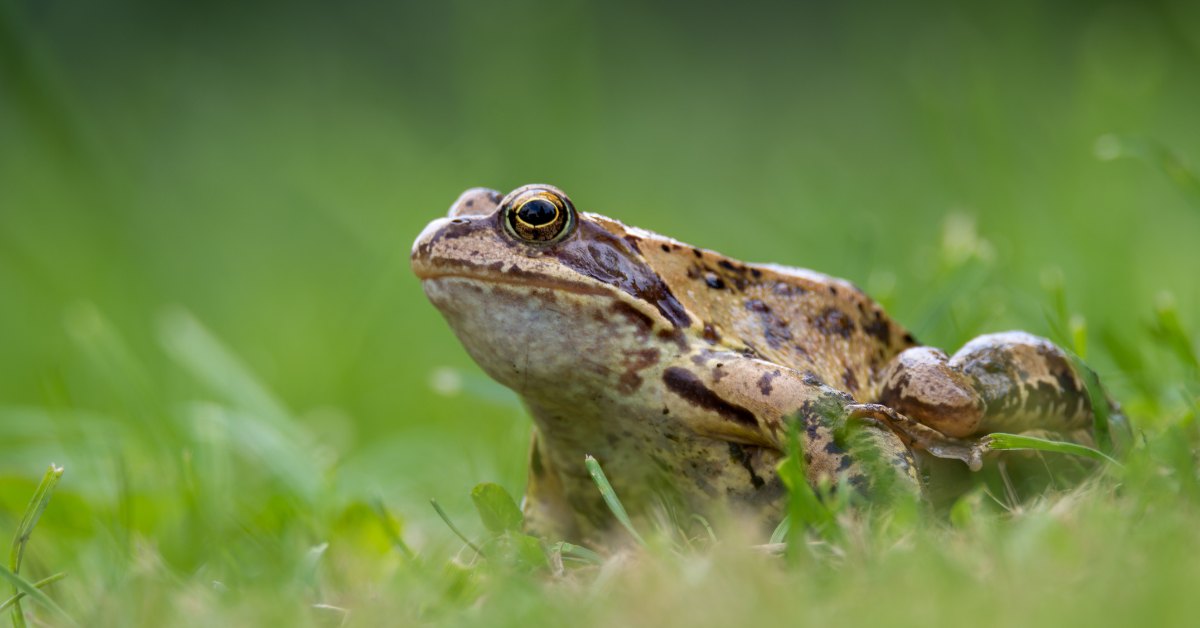
With spring on the horizon, it’s the start of the action for toads (Bufo bufo). They’ll all begin moving as soon as they can toward the pond where they were born to breed: the aim is survival and the continuity of the species. But the world has grown tough for wild creatures like amphibians, and a bit of your help would be welcome.
How to Help Toads?
In France, there are three main toad species: the common toad, the calamite toad, and the green toad. These amphibians belong to the Bufonidae family, the “true” toads. Other species, such as the midwife toad or the yellow-bellied toad, look similar but aren’t part of that family. All told, toads comprise only a small fraction of the amphibians living in the country. Quiet and often maligned, they nonetheless play a crucial role in ecosystems, notably by keeping insect populations in check.
But behind this quiet diversity lies a reality that is far more fragile. Toads are among the most threatened amphibians, especially because of human activities.
A study has shown(1) (and others have noted) that 30% of adult female toads and 30% of mature males die while crossing a road that sees about ten cars per hour.
Reducing Road Mortality
While many scavengers and other small carnivores like the weasel feast on road-kill, it remains a staggering mortality rate for a species that is common, yet under heavy human pressure.
Several organizations are working to persuade local, county, and regional authorities to implement measures such as toad tunnels (to help toads cross beneath roads) or fencing barriers to steer them away from traffic.
Don’t hesitate to back these local initiatives; you’ll help protect and safeguard thousands of toads!
Provide Shelters in Your Garden
Simple stacks of dead wood left in place year after year will give toads cool, humid refuges essential for their survival.
The same goes for stone piles, which you can even arrange in an aesthetically pleasing way as dry-stone features, providing toads with shelter to get through the winter.
In either case, go at it with intention. Build “piles” about one and a half meters in diameter and 60–80 cm tall to make them more attractive to toads.
Eliminate Pesticides
Just as the hedgehog is highly sensitive, the toad is extremely sensitive to chemical products, which you should therefore ban from your home.
This isn’t about debating their use, but about stopping their use altogether, because toads will be among the first animals to suffer outright.
Let the Grass Grow
If you own an orchard, any piece of land, or even a forest, you can do more for toads by letting the grass grow rather than mowing or cutting it back regularly.
Tall or semi-tall grasses allow toads to move more quietly and thus avoid predators that would prey on them, while also keeping them cooler… Essential for animals that live in aquatic environments!
Edges, banks, and other borders are ideal places to let Nature take its course.

Install a Pond, Even If Temporary
Ponds can appear in many forms, such as when a tree is uprooted and drops into a big hole: the hole fills with water and becomes a pond.
These ponds, and others, can fill year-round depending on climates or annual rainfall; but they can also dry up once summer arrives. All of this is not inherently a problem for toads, who adapt to the situation after the few years needed for this amphibian to learn all the possibilities of a site.
However, when humans want to micromanage everything, the emergence of natural ponds has become rarer. You can imagine letting a depression fill up with water and then dry out by June, or take a bigger step and create a pond from scratch.
And if one day toads show up at your place, you’ll be able to tell yourself that this umbrella species in your garden is a sign that they’re thriving!
- https://link.springer.com/article/10.1007/BF00379622