
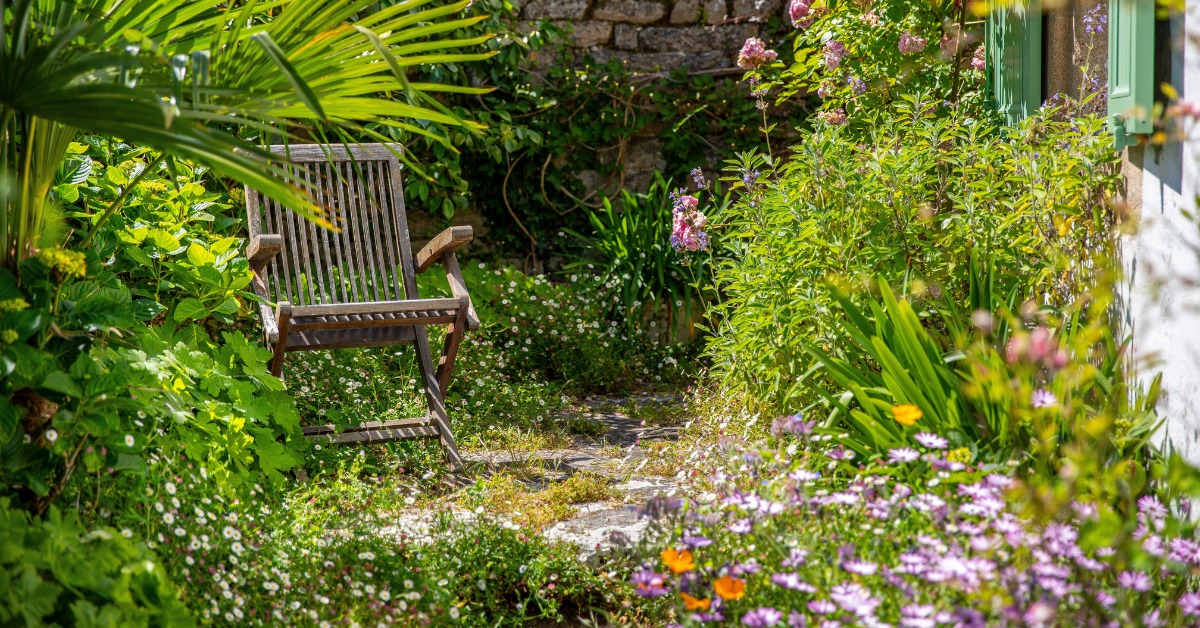
Long perceived as a “neglected” garden, the wild garden is shedding that image today. As droughts take hold, pollinators decline, and garden maintenance becomes more costly in water, time, and energy, this looser model is drawing more people in. And it does not rest on abandoning the land, but on a different way of gardening.
Because giving more space to living things, reducing interventions, and accepting a degree of unpredictability can make a garden both more resilient, more welcoming to biodiversity… and often more pleasant to live in.
Pourquoi un jardin sauvage ?
The notion of a “wild garden” takes root – so to speak – in the English Romanticism of the 19th century, notably in the writings of the Irish gardener William Robinson (1838-1935), author of The Wild Garden (1870).
To give his gardens a more natural character, William Robinson wanted to let rustic flowers enter. At the time, the approach was mainly aesthetic. It aligned with a sensibility akin to Byron’s poetry or the Brontë sisters’ novels.
But today, as intensive agriculture reshapes landscapes and wetlands, fallow lands or wild moors disappear in favor of activities deemed more “profitable,” the idea has become much more ecological. The aim is now to reintroduce nature into nonproductive spaces linked to human activity, in order to support biodiversity, to create movement corridors for species, to preserve native plants, and to sharply reduce chemical inputs.
Thus, gradually, public gardens, road edges, paths, some roundabouts, and, of course, private gardens, are transforming and becoming a little wilder.
Par où commencer ?
The first thing to do may be… nothing. Or rather: don’t rush. “Wilding” one’s environment isn’t a one-afternoon matter. It’s a transition that calls for observing before acting.
Start by looking at your land as it already is. Where does the soil stay cool? Which areas dry out quickly? Where are the insects most present? Which spontaneous plants return year after year? These are often the first clues about what your garden can become.
There isn’t a single way to create a wild garden. It all depends on soil type, available area, climate, your objectives, and the time you want to devote to maintenance. A semi-natural rock garden in a Mediterranean climate, a small orchard-vegetable garden, a flowering meadow, a free hedge, a pond, a high-clipped lawn corner: all of these can fall under the same spirit.
The basic principles
In all guides devoted to the natural garden, you’ll find roughly the same foundations. First, give up toxic products for wildlife and flora: chemical fertilizers, pesticides, fungicides, anti-moss products, and other treatments that upset ecosystems. Next, work the soil as little as possible to preserve its structure and the life it harbors.
We also favor ground covers, surface compost, mulching, or green manures to nourish the earth rather than forcing it. Finally, we mix plantings, giving priority to local species, robust, nectar-rich or wildlife-providing for fauna. And above all, we accept not being able to control everything: a less-mowed lawn, preserved deadwood, a few spontaneous plants left in place can be enough to deeply change the garden’s balance.
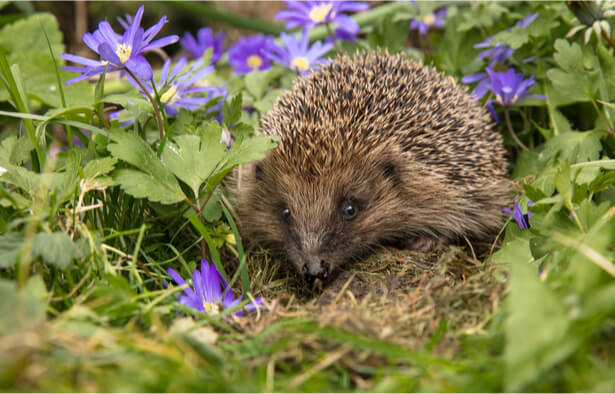
The idea is simple: let natural balances rebuild gradually. If your salads are eaten by slugs, the first reaction is often to remove them. In a wilder garden, we ask another question: why aren’t the natural slug predators there? Hedgehogs, toads, birds, ground beetles… all need shelter, water, quiet. The pest problem is addressed less through direct combat and more through restoring a living habitat.
A wilder garden, but also more resistant to heat waves
It’s perhaps one of the most tangible reasons for the renewed interest in this type of garden. A space that is mowed very short, very mineral, very “clean” heats up quickly, dries quickly, and requires more watering. By contrast, a denser garden, mulched, shaded in places and populated with plants suited to the local climate, resists heat episodes better.
Tall grasses protect the soil, hedges cut the wind, ground covers limit evaporation, organic matter improves water retention. It isn’t dramatic in a single day, but over a whole season the difference can be clear. The wild garden is therefore not only a gesture for insects or birds: it’s also a practical response to a harsher climate.
Some simple project ideas
The easiest place to start is sometimes simply to stop mowing everywhere. Or at least to leave an unmowed zone, or to mow only at certain times, to encourage the appearance of wildflowers that feed insects, which in turn feed birds and the entire living chain.
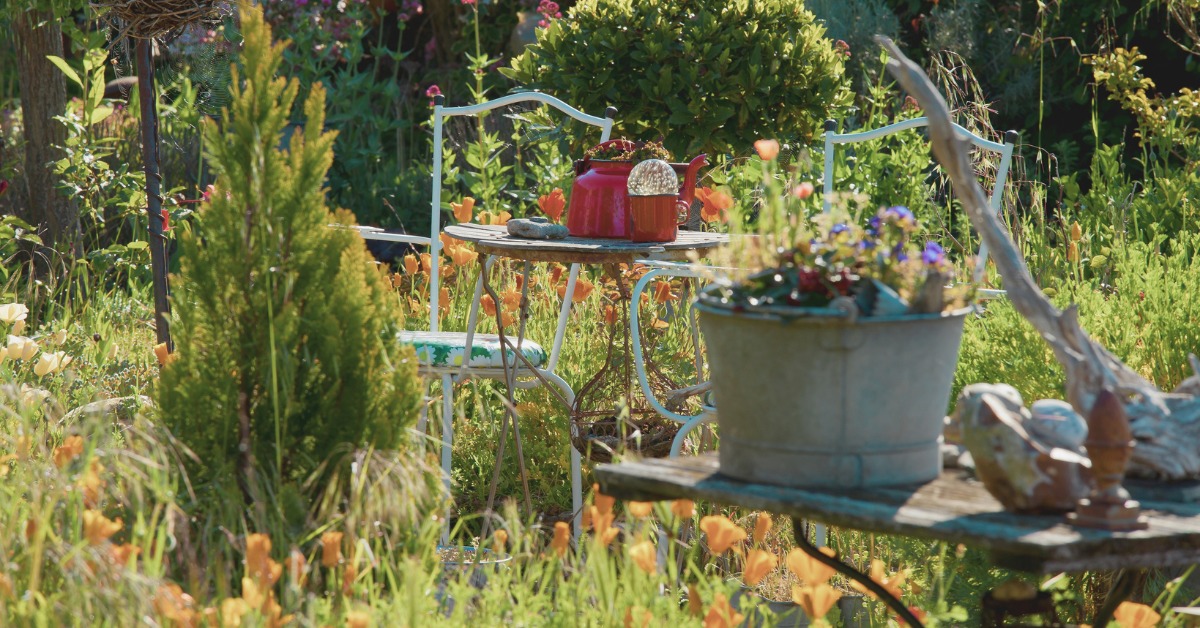
Another idea: build a small dry-stone garden wall, without cement, to offer refuges to insects, lizards, toads, and certain spontaneous plants. You can also plant a free-form hedge made up of flowering shrubs, berry-bearing species, and evergreen plants to provide both food and shelter for wildlife.
These modest gestures have one advantage: they don’t require starting from scratch. They allow you to test, observe, and then go further if the experiment proves convincing.
The orchard-vegetable garden
Orchard-vegetable gardens or semi-wild gardens also provide a relatively simple solution for amateurs. ConsoGlobe asked Olivier Barbié, founder of the School of Sustainable Agriculture in Albi and author of Abrégé d’agriculture naturelle.
“Establishing a wild garden is very simple. We need to demystify it. After all, why would it be difficult to let nature take its course? It’s the opposite that’s difficult.”
Olivier Barbié explains that there are two transitions: “start on tilled soil or on meadow/lawn. On meadow, work the soil 5 cm in the first year. Alternative: cover the soil with 3 to 5 cm of organic matter, such as straw, BRF, compost.”
“The starting sequence for the wild garden goes like this: sow by broadcasting a mix of small seeds of vegetables, flowers, perhaps herbs and trees. This sowing is repeated every 10 to 15 days to introduce seasonal vegetables.”
The large seeds and plug plants can then be installed more freely, while the garden’s perimeter is transformed into a hedge, complemented as needed by fruit trees.
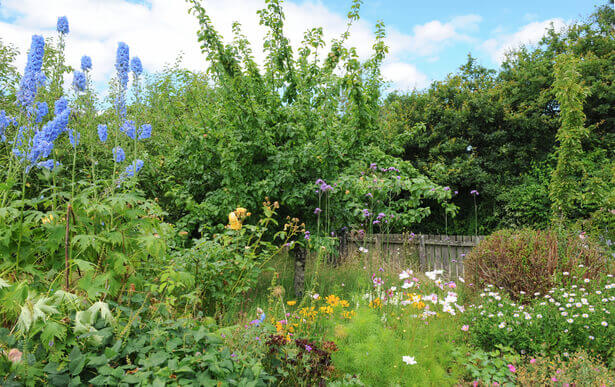
“In the case of the natural garden, a bit less wild but also more productive, sow seeds in lines after lightly scratching the soil, then pair two or three vegetables on each bed.”
These associations help multiply harvests on the same area, while keeping the soil occupied longer. It’s an interesting approach for those who want a livable production that welcomes wildlife, without turning into a rigid, traditional kitchen garden.
Should we let it all go?
No. That’s perhaps the biggest misconception about wild gardening. Such a garden demands less domination, but not less attention. You must observe, arbitrate, contain certain species if they take over, protect young plants, maintain pathways, and consider the overall balance.
In other words, the wild garden is not a renunciation. It’s a garden steered differently: less geometric, less wasteful in water and inputs, but often richer, more alive, and smarter in its relationship to the place.
- Lao Tzu: Chinese sage, contemporary of Confucius, considered the founder of Taoism
- Books to consult: Olivier Barbié, The Abrégé of Natural Agriculture, ITAN, 2006 (ISBN 978-2748310917) ; Jean-Marie Lespinasse: The Natural Garden, Éditions du Rouergue, Rodez, 2009, 186 pages (ISBN 978-2-8126-0025-8)
- Books to consult: Olivier Barbié, The Abrégé of Natural Agriculture, ITAN, 2006 (ISBN 978-2748310917) ; Jean-Marie Lespinasse: The Natural Garden, Éditions du Rouergue, Rodez, 2009, 186 pages (ISBN 978-2-8126-0025-8)