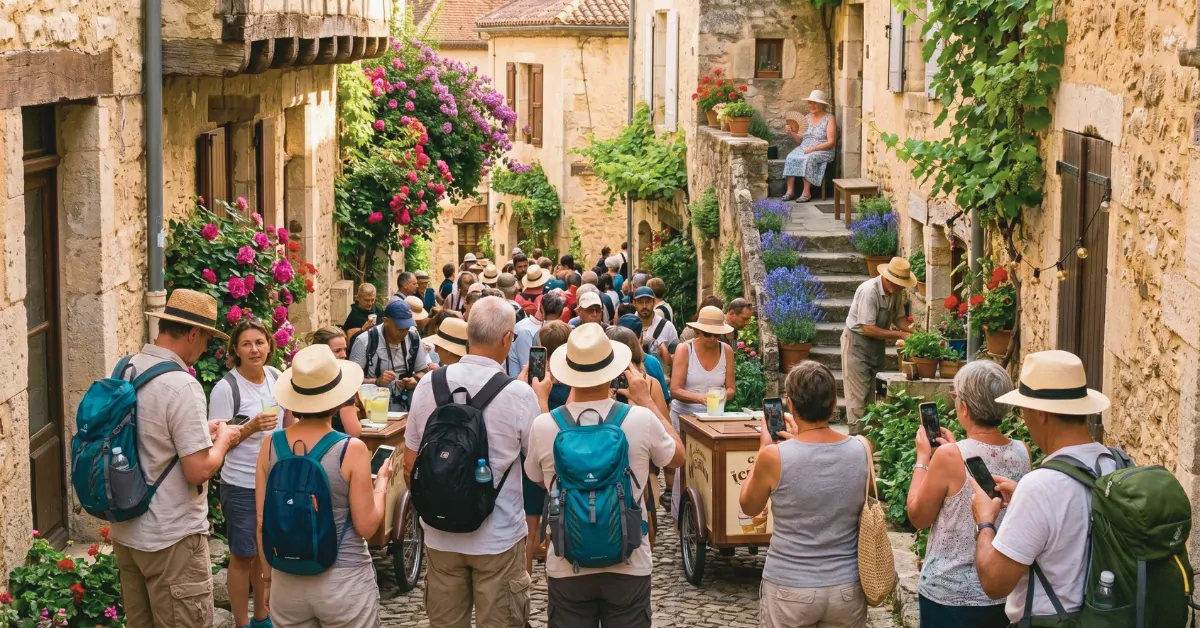
The International Maasai Solidarity Alliance is calling for the expulsion of a UNESCO site from the World Heritage List. Their crime? Practicing a form of pastoralism that has preserved Tanzania’s ecosystem for centuries, yet disturbs the green industrial vision of the West. In Vlkolínec, Slovakia, the last 20 inhabitants suffocate under the weight of 100,000 visitors each year. Everywhere, the label meant to protect heritage now seems to accelerate its ecological and social destruction.
Ngorongoro: When protecting the ecosystem means expelling those who preserved it for millennia
The Ngorongoro Conservation Area embodies the ultimate paradox of UNESCO policy. Inscribed on the World Heritage List for its exceptional biodiversity, the area is home to Maasai pastoralist communities who have coexisted with wildlife for millennia. Yet, the conservation policies imposed since inscription have gradually displaced these communities from their ancestral grazing lands.
The Maasai International Solidarity Alliance today denounces a perverse logic: in the name of environmental protection, the international organization justifies the expulsion of populations whose farming practices have sustained ecological balance for centuries. The areas off-limits to Maasai herds become high-end safari attractions, generating revenues that never benefit local communities.
The Maasai Pastures: a Model of Ecological Coexistence Misunderstood by the West
Mobile pastoralism practiced by the Maasai stands in stark contrast to mass tourism. The herds move according to the natural cycles of rainfall, enabling the regeneration of pastures and maintaining a mosaic of habitats favorable to biodiversity. Controlled fires prevent shrub encroachment and promote herbaceous plants upon which wild herbivores depend. Animal waste naturally fertilizes soils without chemical inputs.
This traditional agro-ecological system directly contradicts the Western conservation doctrine inherited from the 19th century, which envisions nature as a virgin space to be protected from any human presence. Greg Richards, a researcher specializing in cultural tourism, notes that “authenticity is a very dangerous word because it can be interpreted in many different ways.” UNESCO applies an imported framework, ignoring that Ngorongoro’s ecological balance results precisely from the human interaction with the environment.
UNESCO Policies versus Traditional Pastoral Ecology: Two Irreconcilable Visions
Peter DeBrine, a sustainable tourism expert at UNESCO, acknowledges that “tourism has changed dramatically over the last 10 to 15 years.” Yet, the organization admits it has no mechanism to delist a site when local communities suffer from the preservation policies imposed. Asked about the possibility of intervening when residents suffer from tourism or conservation measures, DeBrine answers bluntly: “We don’t really have a mechanism for that.” The impasse is explained by UNESCO’s very structure. John H. Stubbs, former vice-president of the World Monuments Fund, reminds us that “UNESCO’s creed concerns shared heritage, its conservation, its celebration, and its recognition as a human achievement.” Nowhere in that mandate does the question of local consent or the real ecological sustainability of the imposed conservation models appear.
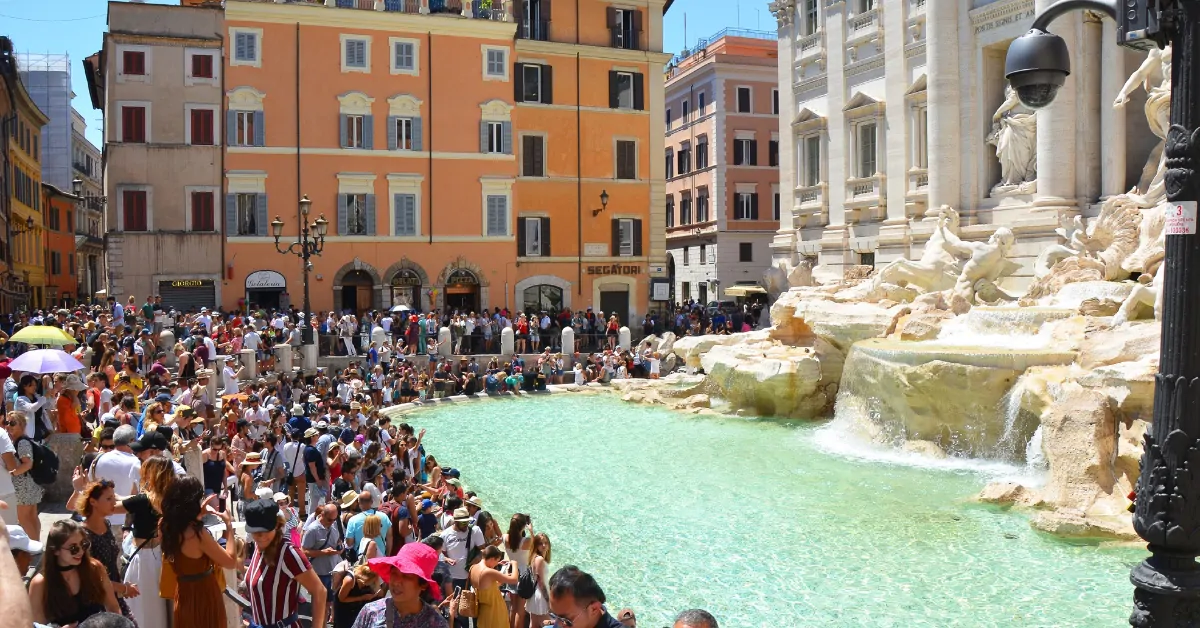
Of the 1,248 sites inscribed on the World Heritage List in 170 countries, only three have ever been delisted since the list’s creation in 1978. All for reasons of architectural or natural conservation deemed insufficient, never for negative ecological or social impact. The Arabian oryx Sanctuary in Oman lost its status in 2007 after the protected area was reduced in favor of oil exploration. The Elbe Valley in Dresden was delisted in 2009 following the construction of a bridge. Liverpool left the list in 2021 after disagreements over the reconfiguration of the waterfront. No withdrawal has ever punished the ecological damage of mass tourism.
Over-tourism as an ecological bomb: Venice and the destruction of aquatic ecosystems
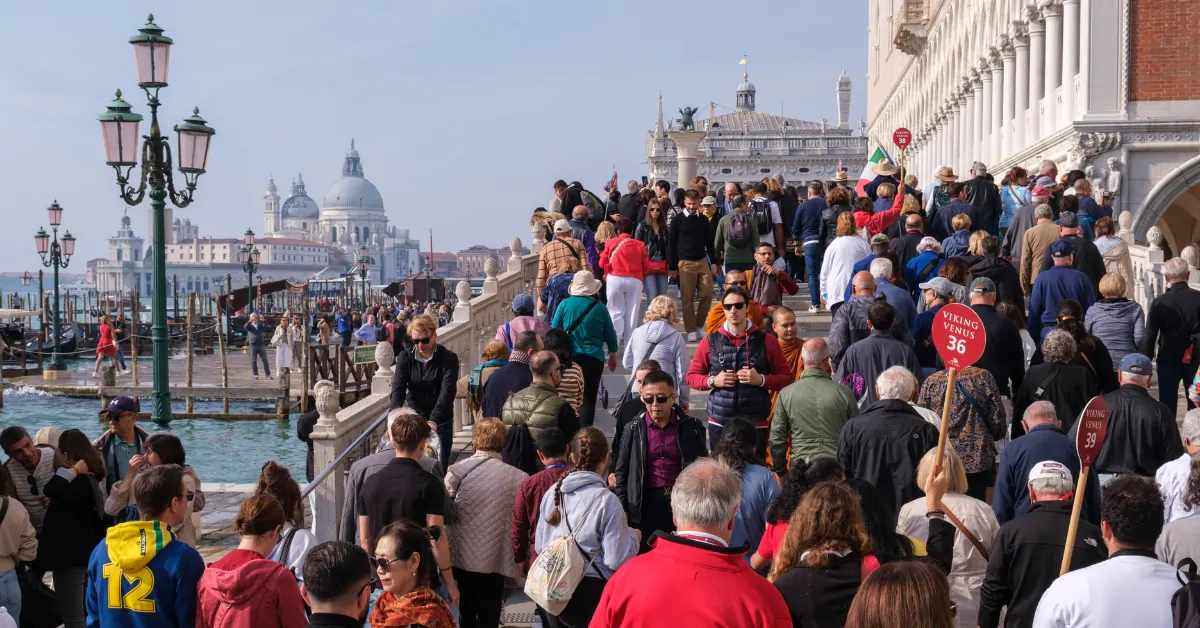
Venice starkly illustrates the environmental dimension of over-tourism. Declared a World Heritage Site in 1987, the lagoon city has become one of Europe’s most over-touristed destinations. Motorboats and cruise ships generate a destructive wake, causing accelerated erosion of foundations and disruption of lagoon ecosystems. The wastewater discharges from tourist infrastructures overwhelm the lagoon’s natural treatment capacity. Residents are fleeing in large numbers: from 175,000 inhabitants in 1950, Venice now has fewer than 50,000 permanent residents, while the annual influx surpasses 30 million visitors.
The phenomenon, described by preservation researchers as museification, gradually turns a living place into a site aimed exclusively at visitors. Local shops give way to souvenir stores. Homes become tourist rentals. Water-supply and waste-management systems designed for a resident population crumble under tourist pressure.
How 100,000 annual visitors devastate the natural balances of a small village
Vlkolínec, a Slovak village of 45 colorful cottages around an 18th-century church bell tower, had about 20 permanent residents before its 1993 inscription. The influx of more than 100,000 visitors per year has since transformed the hamlet into a dead magnet. Traditional kitchen gardens are disappearing, replaced by makeshift parking lots. The constant automobile traffic compacts soils and destroys historic rural footpaths. Individual sewage systems, sized for a handful of homes, regularly discharge untreated wastewater into nearby waterways.
The environmental impact of tourism extends far beyond the carbon footprint of travel. The hosting infrastructures, even minimal, fragment natural habitats. Repeated trampling erodes soils and destroys spontaneous vegetation. The noise and constant hustle disrupt local wildlife. In Lijiang, China, inscribed in 1997, entire neighborhoods have transformed into hotel-commercial zones, replacing traditional gardens and ancestral hydraulic systems with concrete and energy-hungry air-conditioning.
Social media magnifies the phenomenon exponentially. TikTok and Instagram instantly turn obscure sites into viral destinations, generating unmanageable tourist flows within months. Local communities have no way to control this explosion(1) or to negotiate with an international organization that, by its own admission, has no lever of intervention.
Toward a Green UNESCO: recognizing Indigenous rights as a pillar of conservation
Peter DeBrine says that “World Heritage sites are for everyone. They belong to all of humanity. We want people to visit them and experience them.” Yet the notion of a common heritage of humanity runs directly against Indigenous territorial rights and ecological practices. Conservation can no longer ignore that the world’s best-preserved ecosystems are precisely those that are lived in and managed by communities using time-honored knowledge.
In Marrakech, inscribed in 1979, over-tourism and foreign investment in the medina have driven real estate prices up, expelling longtime residents and destroying the solidarity networks that kept the traditional urban fabric intact. Riads converted into guesthouses consume unsustainable amounts of water in a semi-arid region. Local, context-appropriate energy solutions give way to standardized, energy-intensive equipment.
The calls for the withdrawal by Vlkolínec and the Maasai Alliance pose a radical question: can UNESCO evolve from an extractive conservation model toward a genuinely ecological approach that recognizes local populations as legitimate guardians of their territories? Or will it remain trapped in a neocolonial logic where the West defines what deserves protection and how, without ever questioning the environmental and social consequences of its own criteria?
- https://www.cnews.fr/monde/2026-06-16/unesco-plusieurs-sites-demandent-ne-plus-etre-inscrits-au-patrimoine-mondial