
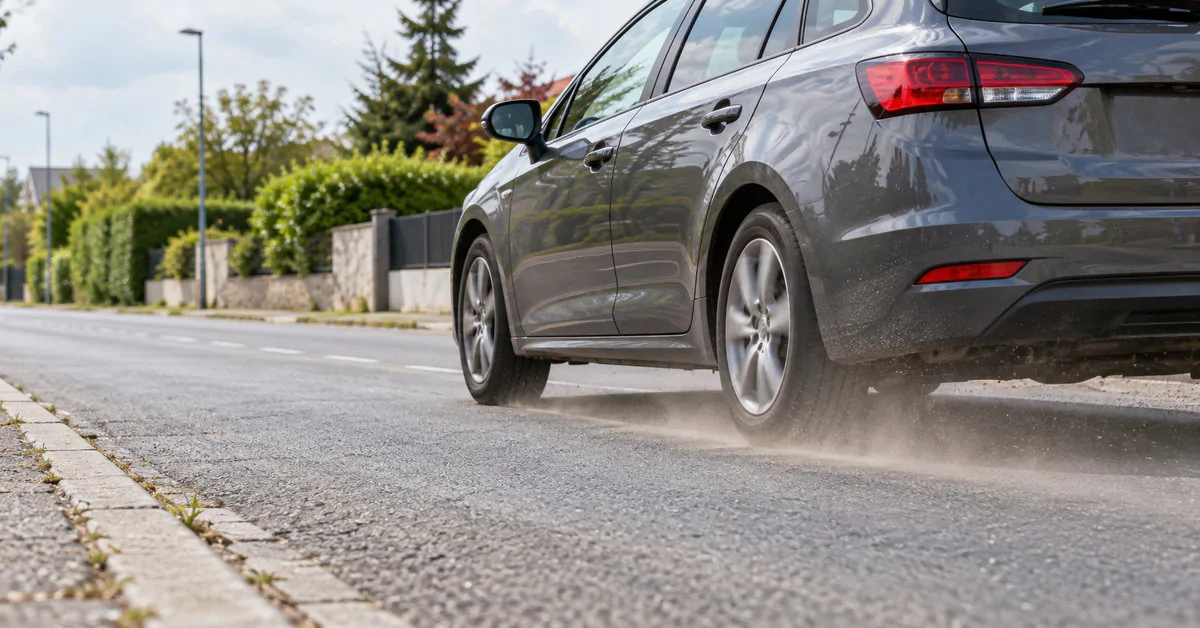
When a car passes by, it doesn’t just pollute through its exhaust or tire wear. Its movement can also kick up particles already deposited on the roadway. Speed plays a major role in this phenomenon, according to the CEPARER project, published by ADEME on October 7, 2026.(1)
Where do car-suspended particles come from?
On the road, dust from diverse sources accumulates. Some come from tire wear, brake wear, or the road surface itself. Others are brought in by wind or surrounding activities. The passing of a vehicle can resuspend them.(2)
This distinction matters: a particle raised by a wheel does not necessarily originate from that particular car. It may have been deposited earlier and then re-entrained by traffic.
Emissions from tire and brake wear are better understood. The resuspension of road dust, however, remains harder to measure.
What CEPARER Reveals About Speed
Led by ESTACA with Airparif and UTAC, the CEPARER project combined bench tests and track testing. Researchers developed a device capable of measuring resuspension in a ventilated, controlled environment.(1)
They specifically studied the influence of speed, vehicle characteristics, tires, and particle size. Speed emerges as a major factor in the measured emission levels.(1)
The study thus helps clarify a pollution mechanism that had been less documented until now. It does not, however, provide a universal reduction percentage that applies to all roads. Road surface condition and traffic conditions can alter the result.
An Electric Car Also Kicks Up Dust
An electric car does not emit particulates from exhaust during operation. Its regenerative braking also reduces brake wear. However, its tires roll on the roadway and its passage can re-suspend dust.(3)
That does not mean electric and internal-combustion engines have the same overall environmental impact. CEPARER studies a specific air-pollution mechanism. The project does not compare their greenhouse gas emissions across their full life cycles.
Should speed limits be lowered?
The role of speed observed by CEPARER invites closer scrutiny of the effects of speed limits. But a lower speed alone does not guarantee a reduction in all forms of pollution.
The number of vehicles, congestion, and accelerations also influence air quality. A previous ADEME synthesis showed that the effects of limits vary based on the initial speed and traffic conditions.(4)
To protect residents, we need to look at traffic as a whole. CEPARER adds a new piece to this equation: what was already on the road can re-enter the air as the next vehicle passes.
Also read
Car tires pollute even our plates
- https://librairie.ademe.fr/recherche-et-innovation/9659-11495-projet-ceparer-caracterisation-des-emissions-de-particules-remises-en-suspension-par-les-vehicules-routiers.html
- https://recherche.ademe.fr/index.php/thematiques/air/qualite-de-lair-transports-et-mobilites/ceparer-caracterisation-des-emissions-de-particules-remises-en-suspension-par-les-vehicules
- https://recherche.ademe.fr/thematiques/air/qualite-de-lair-transports-et-mobilites/emissions-de-particules-liees-labrasion-des-freins-des-pneus-et-de-la-chaussee
- https://librairie.ademe.fr/mobilite-et-transports/3637-impacts-des-limitations-de-vitesse-sur-la-qualite-de-l-air-le-climat-l-energie-et-le-bruit.html