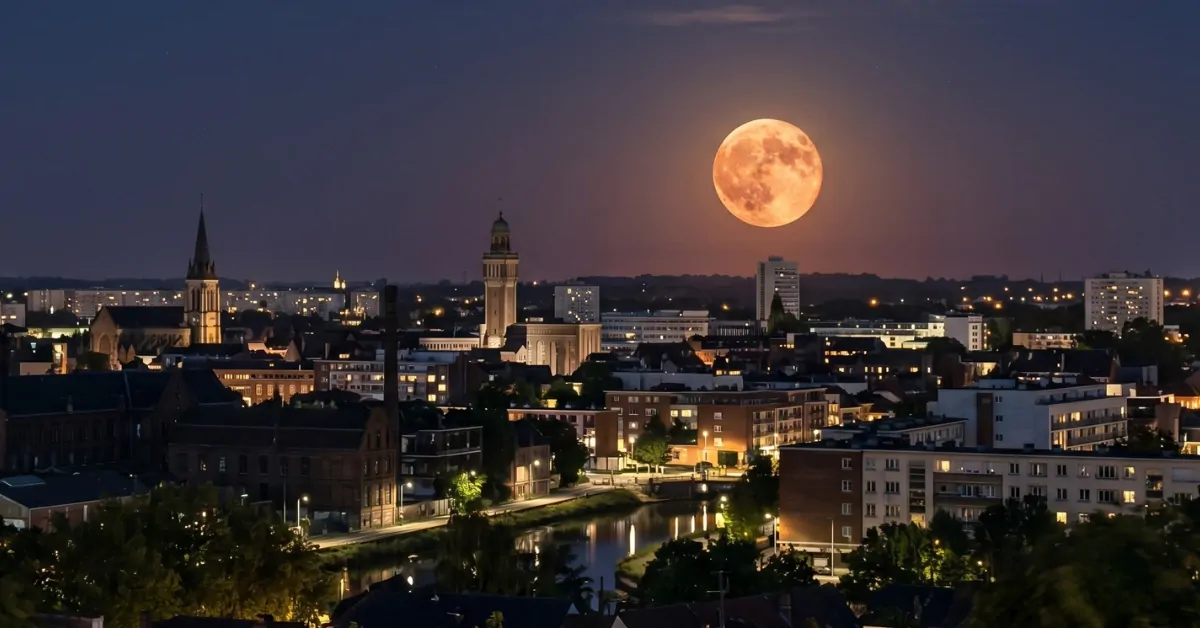
Among Native American traditions, the micromoon phenomenon, and favorable viewing conditions, this event stands as one of the summer’s most anticipated celestial gatherings.
The Strawberry Moon: An Agricultural Marker
On June 29, 2026, astronomy enthusiasts and curious onlookers alike will lift their eyes to the sky to admire the Strawberry Moon. Contrary to what the name might imply, this full Moon will not take on a red or pink hue. This full Moon remains a notable event, in part because it will also be a micromoon, meaning a full Moon observed near the apogee of its orbit.
The name “Strawberry Moon” traces back to Native peoples of North America. According to The Old Farmer’s Almanac, this designation referred to the strawberry harvest that traditionally took place in late spring to early summer. The lunar calendar was then a crucial marker for pacing agricultural work and daily life.
This naming persisted through the centuries before becoming widespread in the Western world. Other cultures, however, adopted different names for the same full Moon. In Europe, it is sometimes called the Rose Moon due to the season’s blossoms. Some traditions also mention the Honey Moon or Mead Moon, terms tied to harvests and celebrations of the warm season.
It is important to note that the term “Strawberry Moon” does not describe the Moon’s appearance: this full Moon does not turn red or pink. Any orange hints seen at Moonrise are mainly the result of atmospheric effects similar to those that color sunsets.
An Enormous Moon: do you know the “Moon Illusion”?
The 2026 edition features several remarkable traits. First, the full Moon will reach its maximum illumination on June 29 at 1:56 a.m. Central European Time. This full Moon will also be a micromoon: the Earth–Moon distance will be about 405,254 kilometers at the moment of transit. This value places the Moon near apogee, the farthest point in its orbit.
Paradoxically, many observers will feel that the Moon appears enormous as it rises above the horizon. This phenomenon, well known to astronomers, is called the Moon Illusion—a perceptual effect caused by the presence of landscape features such as trees, buildings, or terrain.
The Strawberry Moon of 2026 also stands out for its position in the sky. A few days after the summer solstice on June 21, it will trace one of the year’s lowest paths in the Northern Hemisphere. This arrangement stems directly from the geometry of Earth–Moon–Sun at this time of year.
How to observe the June 2026 full Moon in the best conditions?
Observing the Strawberry Moon requires no specialized equipment. Naked-eye viewing will already be impressive if the weather cooperates. Experts recommend aiming for Moonrise, when the Moon often appears at its most dramatic. For American observers, aim toward the southeast horizon in the late evening of June 28 or 29, depending on your location.
Astronomy photographers will also want to plan ahead. A long focal length will capture the Moon’s disk details, while a foreground of monuments, hills, or trees will intensify the striking effect produced by the Moon’s illusion. The use of binoculars can also enhance the experience. Even though the full Moon is not the ideal phase for highlighting lunar relief, the lunar seas and some large craters remain clearly visible. Viewers away from light pollution will enjoy a more comfortable observing environment, though the Moon’s brightness makes it visible from urban centers as well.
A full Moon in a month rich with astronomical events
The Strawberry Moon caps off a June that was particularly lively for skywatchers, with close approaches involving Venus, Jupiter, Mercury, and the Moon in the first half of the month. This full Moon is, moreover, the seventh full Moon of 2026. It occupies an unusual place in the lunar calendar following a second full Moon in May.
Beyond its scientific interest, the Strawberry Moon retains a strong cultural dimension. For centuries, it has symbolically signaled the arrival of summer in the Northern Hemisphere. Its name recalls the old bonds between human societies and the cycles of nature, long before the introduction of modern calendars.
On the night of June 29 into June 30, conditions will be ripe for a celestial display accessible to everyone. Whether it’s a simple naked-eye observation or a more ambitious astrophotography session, this early-summer full Moon promises one of the year’s most beautiful sky-watching moments.