
The year 2025, the fourth warmest on record for mainland France, with an anomaly of +2.4°C relative to pre-industrial levels, sparked two major heat waves that affected 80% of the population. But beyond human costs, it is the ecosystems that are paying the heavy price.
Accelerated melting of Alpine and Pyrenean glaciers: -2.6 m of water equivalent in a single year
French glaciers lost 2.6 meters of water equivalent between 2024 and 2025, according to the latest annual report from the Ministry for the Ecological Transition. This figure greatly exceeds the long-term average of 1.6 meters recorded since the 2000s. Alpine and Pyrenean glaciers are undergoing accelerated melt, directly linked to extreme temperatures and a winter snow deficit. The mountain ranges, sentinels of warming, see their precious freshwater reserves evaporating at an alarming rate. Scientists estimate that some mid-altitude glaciers could vanish by 2050 if the current trajectory continues.
Glacier melt is not merely symbolic loss. Glaciers serve as strategic reservoirs of freshwater for downstream basins, feeding rivers and aquifers during the summer. Their gradual disappearance threatens water supply for Alpine and Pyrenean valleys already weakened by drought. In 2025, 78 departments imposed water-use restrictions by the end of August, a direct consequence of soil drought and dwindling natural reserves. High-altitude aquatic ecosystems, adapted to the cold waters released by melting glaciers, are also undergoing major disruptions, threatening endemic species.
In the Caribbean, 50% of coral reefs disappeared in three years
The Mediterranean Sea experienced in June and July 2025 an exceptional marine heatwave, with surface temperatures about 5°C above normal along the French coastline. These ocean heatwaves, increasingly frequent and intense, place significant thermal stress on marine organisms. Posidonia seagrass meadows, essential to Mediterranean biodiversity, suffered localized die-offs. Fish populations have migrated to deeper or more northern waters, disrupting ecological balances and fishing activities. Scientists warn of the risk of the Mediterranean undergoing a tropics-like shift, with invasive species taking advantage of warming.
In the French Caribbean, the situation is catastrophic: 50% of coral reefs disappeared between 2022 and 2025, according to the ministerial report. Mass coral bleaching, driven by rising ocean temperatures, has reached a critical level. Corals, symbiotic organisms housing microscopic algae, expel these algae when water becomes too warm, losing their color and their nutrition source. Without a rapid return to normal conditions, corals die. Reefs are essential nurseries for marine life and natural barriers against coastal erosion. Their disappearance threatens tropical marine biodiversity and the protection of Caribbean coastlines from cyclones, such as Garance which struck Réunion in February 2025.
French forests: carbon storage in decline and uncontrolled fires
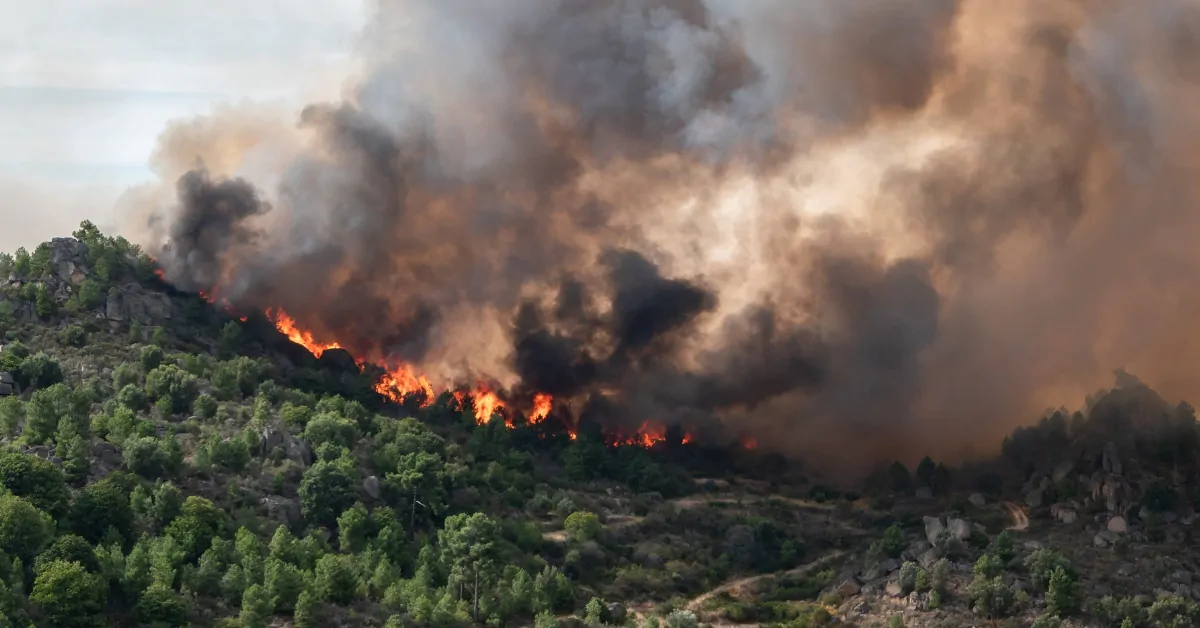
More than 16,000 wildfires and vegetation fires scorched 30,500 hectares in 2025, according to the ministry. Prolonged drought conditions and high temperatures created fertile ground for fires to start and spread rapidly. France’s forests, already weakened by repeated droughts and pest outbreaks favored by warming, see their carbon storage capacity drop by 20% compared with previous decades. Stressed by water scarcity, trees become more vulnerable to fires and less effective at absorbing atmospheric CO2. A vicious circle emerges: warming weakens forests, which store less carbon, accelerating warming.
The Ribaute fire, in Aude, consumed more than 11,000 hectares alone, more than a third of the total area burned in 2025. This major event illustrates the increasing ferocity of wildfires in metropolitan France, traditionally less exposed than the Mediterranean regions. Firefighters faced extreme conditions, with unprecedented spread rates and surface temperatures exceeding 800°C. Mediterranean forest ecosystems, adapted to low-intensity natural fires, cannot regenerate after such violent and frequent blazes. Local wildlife, including nesting birds and land mammals, suffered heavy losses. Burned soils, stripped of vegetation, became vulnerable to erosion during autumn rains, as earlier heatwaves had already shown.
The +1.5°C threshold exceeded: when tipping points loom closer
The symbolic threshold of +1.5°C global warming above pre-industrial levels, set by the Paris Agreement, was exceeded on average in the past three years (2023-2025). In mainland France, warming reached +2.2°C over the 2016-2025 period, almost twice the global average. IPCC projections anticipate an increase of +2.7°C by 2050 and +4°C by 2100 if greenhouse gas emissions do not fall drastically. French ecosystems, already under multiple stresses, are nearing irreversible tipping points.
The Minister of Ecological Transition, Monique Barbut, argues that “every euro spent on adaptation saves between 2 and 10 euros in avoided damages.” Yet France must accelerate its adaptation efforts in the face of environmental degradation that threatens biodiversity, water resources, and the stability of ecosystems on which our collective survival depends. Natural cycles, from bird migration to pollination, are experiencing increasing disruptions that call into question the fragile balance of living systems.