
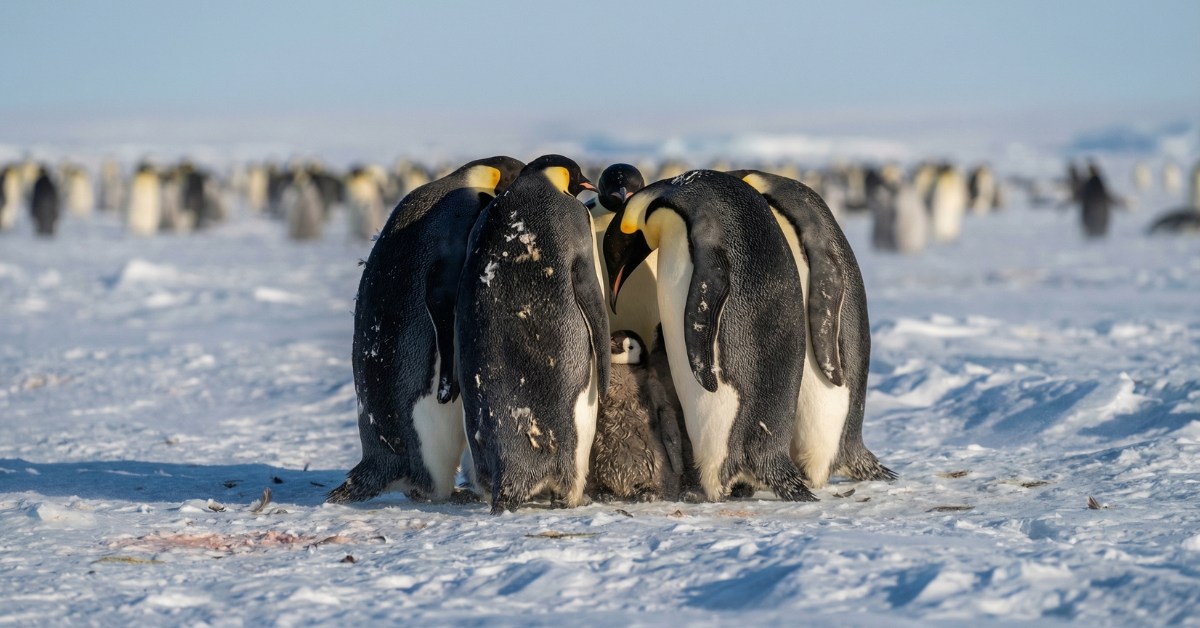
As sea ice retreats, an entire biological balance teeters. Behind this verdict, scientists describe an inexorable mechanism: less ice means less reproduction, less food, and, in the long run, a possible collapse of populations if warming continues at the current pace.
Emperor penguin: its population, already in steep decline, is expected to fall further
The emperor penguin, Antarctica’s iconic species, is now considered endangered. This decision by the International Union for Conservation of Nature (IUCN) was made at its latest congress, which just concluded in Samarkand, Uzbekistan. It rests on a growing body of converging scientific evidence. The primary factor is identified unambiguously: climate change, which acts directly on their habitat. Indeed, these seabirds depend entirely on sea ice for their life cycle. It serves as a breeding platform, a resting zone, and a gateway to food. Yet this icy surface weakens year after year due to rising temperatures. Between 2009 and 2018, the global emperor penguin population had already fallen by 10%, roughly 20,000 adult birds disappeared. Even more worrying, projections point to a 50% decline by the 2080s.
The emperor penguin is the largest penguin species in the world. It lives exclusively in the harshest regions of Antarctica, where temperatures can drop below -50 °C. Its reproduction rests on a fragile balance. Adults cluster on the sea ice in the austral winter, where females lay a single egg entrusted to the male. He guards it for several weeks in extreme conditions, without feeding. Any disruption to this environment can have dramatic consequences. The early melting of ice, now more frequent, prevents the young from surviving: episodes of mass chick drownings have been observed when the ice breaks before they are able to swim.
Kerguelen fur seal and southern elephant seal: the situation is equally worrying
The emperor penguin case is not an isolated exception. It fits into a broader upheaval of Antarctic ecosystems. The Kerguelen fur seal, another iconic species, has also been reclassified as “Endangered.” Its population has fallen by more than 50% since the late 1990s. The main cause is the dwindling krill, a tiny crustacean essential to the food chain. And krill itself depends on sea ice to thrive.
Another decision from this IUCN gathering: the southern elephant seal is now considered vulnerable, in particular due to outbreaks of avian influenza. This health factor adds to the environmental pressures already at play.
All of these elements paint a troubling picture. Polar ecosystems, long seen as relatively pristine, are now showing themselves to be unusually vulnerable to global changes.
Emperor penguin, emblem of a global climate emergency
In response, calls to action are multiplying. “These important findings should spur decisive action to combat climate change,” insists Grethel Aguilar, director-general of the IUCN. The message is clear: the ongoing loss of sea ice is not just a localized problem—it is a global indicator of warming and its impacts on biodiversity.
Today, the global population of emperor penguins is estimated at around 228,000 breeding adults. It remains a significant number, but it could rapidly collapse without concrete measures. Scientists remind us that the species’ survival directly depends on our ability to limit warming. Stabilizing temperatures would help preserve a portion of the sea ice, and thus maintain the conditions necessary for their reproduction.