
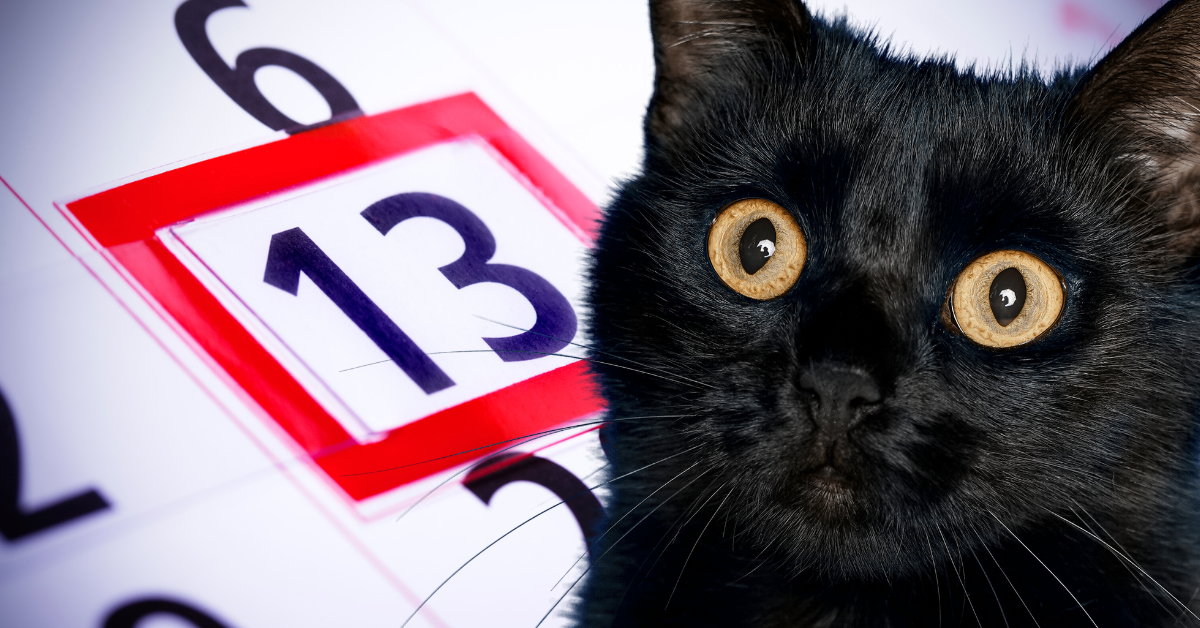
Friday the 13th is, for many people, a day of luck, which gives rise to a special Friday the 13th lottery. For even more people, however, the day is associated with bad luck, and this has been the case for hundreds of years. So where do these beliefs come from?
Friday the 13th: origins of the superstitions, luck or misfortune?
Fans of odd facts, you can use the word borrowed from Greek “paraskevidékatriaphobe,” the adjective designating a person who fears Friday the 13th.
Many people are paraskevidekatriaphobes
And it takes many forms: people avoid scheduling events on a Friday the 13th. The fear of Friday the 13th is double: it combines the aversion to Friday and the triskaïdékaphobie, i.e. the phobia of the number 13.
The terror of 13 is so widespread that it shies away from many situations: we rarely gather 13 guests at a table. It is avoided for events, especially those involving risk, such as in airplanes where the 13th row often does not exist most of the time.
In buildings as well, where, for the same reason, the 14th floor artificially replaces the 13th floor, or that floor is simply closed to the public. In the latter case, however, it was originally a technical constraint; the architecture of New York in the 1930s advised not to exceed thirteen floors for safety reasons(1).
A mix of superstitions
The origins of the superstitions around Friday the 13th are actually somewhat blurred, and while there isn’t a single version, they are invariably linked to an occidental (Western) origin. In some countries, other numbers are even more terrifying than 13, such as 39 in Afghanistan(2), the number 4 in many East Asian countries(3), or 7 in China(4) and Japan.
Thirteen, however, is notably linked to the Last Supper described in the Bible. Thirteen diners, including a traitor, Pontius Pilate, who leads Jesus to his downfall. And the Christ would have died on a Friday, hence the tradition of Good Friday.
Friday itself is associated with various negative beliefs, such as the story of the Norse goddess Frigg (or Frigga), wife of Odin and banished by Christianity, who would come to take revenge each Friday by sending a devil and twelve witches(5).
And Friday the 13th is linked to several negative episodes in history, beginning with the arrest of the Knights Templar by Philip the Fair on Friday, October 13, 1307, which could be the origin of paraskevidekatriaphobia.
More recently, events such as the Paris attacks in 2015 have fed this fear, the symbolism perfectly capable of leading to symbolic terrorist acts.
Conversely, other people are firmly convinced that the number 13 brings luck. A secret society founded at the College of William and Mary, the second oldest university in the United States after Harvard, was called The Thirteen Club, to counter the idea that thirteen people at table brings bad luck.
Real-world consequences on the economy

Research does not show a rise or fall in luck on Friday the 13th(6). However, researchers warn about the influence of cognitive biases, pushing those working in the medical field to tilt the logic toward misfortune when faced with an activity choice(7).
The fear of Friday the 13th, much like the coronavirus at the start of 2020, slows the economy, if only through many people choosing not to travel, work, or do business, and this impact is felt even in Asian markets on a rebound(8).
Yet studies show that the stock market tends to perform better on Fridays the 13th on average. So this would simply be one cognitive bias.
Like any phobia, paraskevidekatriaphobia is irrational; just like the mood of the day, it simply but deeply influences our ability to make decisions(9).
The Dutch Center for Statistics also highlights another consequence(10): Friday the 13th would make people more cautious.
Still afraid of Friday the 13th? Also consider the other traditions! In ancient Rome, the number 13 was not very positive because it broke harmony, just as in ancient Greece, Friday was the day of Venus, the goddess of love.
- Glaeser, Edward. Triumph of the City. Penguin Press, 2011.
- https://www.lefigaro.fr/flash-actu/2014/07/22/97001-20140722FILWWW00150-l-afghanistan-et-la-malediction-du-numero-39.php
- Comme l’atteste le livre suivant : Chevalier, Jean et Alain Gheerbrant. Dictionnaire des symboles. Éditions Chevalier, 1982.
- https://www.cchatty.com/14-numbers-and-Chinese-culture-g-100088
- Dictionnaire des symboles
- Fidrmuc, Jan, and Juan de Dios Tena. « Friday the 13th : The empirics of bad luck. » Kyklos 68.3 (2015) : 317-334.
- Vinson, David R. « Superstitions in medicine : bad luck or bad logic ?. » Annals of emergency medicine 31.5 (1998) : 650-652.
- Auer, Benjamin R., and Horst Rottmann. « Is there a Friday the 13th effect in emerging Asian stock markets ?. » Journal of Behavioral and Experimental Finance 1 (2014) : 17-26.
- Dixon, Jacob, and Katrina Franda. « Friday the 13th : How Superstitions, Luck, and Mood Influence Decision Making. » (2019).
- https://uk.reuters.com/article/us-luck-idUKL1268660720080613