
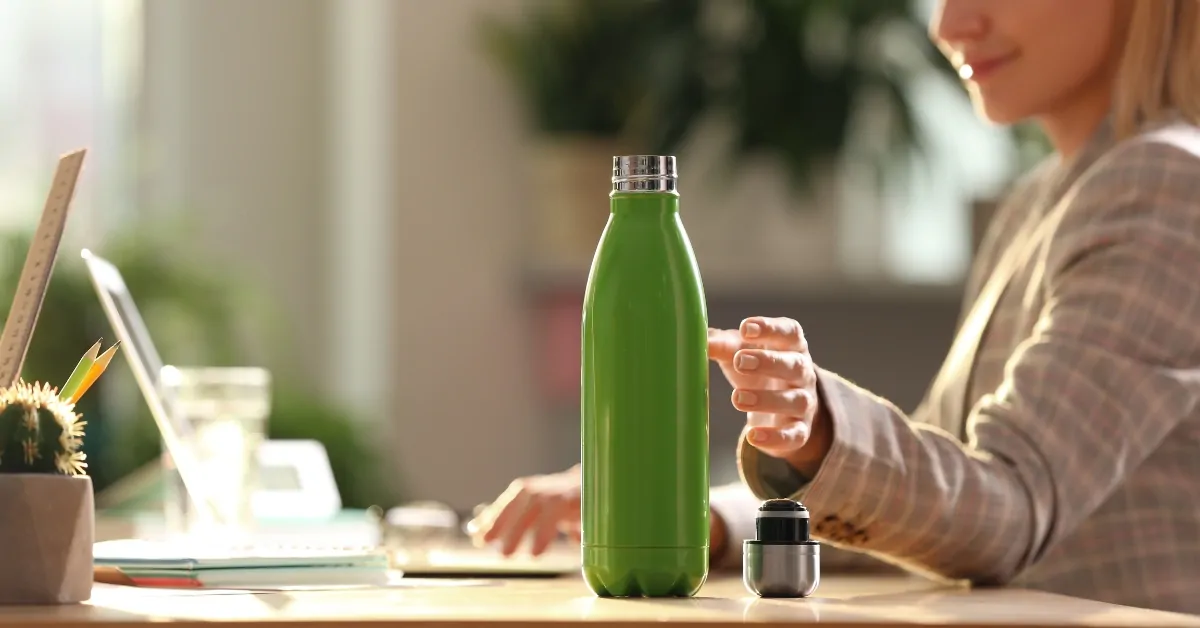
The stainless steel water bottle is a good alternative to plastic bottles and even to plastic water bottles. But how do you clean a dirty bottle or thermos?
Moreover, a well-maintained bottle can last for many years. A few minutes of regular cleaning not only protects your health but also extends the life of your reusable container. A simple habit that fits perfectly into a zero-waste lifestyle.
Cleaning your stainless steel water bottle or thermos, a necessity
The reusable bottle, especially the stainless steel bottle, is good for the environment since it avoids using single-use plastic bottles. According to several studies, it is nevertheless often a noteworthy source of microbial diffusion.
The water bottle, top winner in the daily dirty-objects ranking
In the ranking of the dirtiest objects in our daily lives, we typically have a mental list. The toilet bowl, the kitchen sponge, the broom, for example. We now know that electronics aren’t left out. The remote control is very dirty, the computer keyboard as well, the ATM is not immune. The mobile phone is one of the dirtiest objects we use. And yet a study has shown that the dirtiest object is often not what we think: it’s the reusable water bottle.
This situation is due to the formation of a biofilm (1), that is, an accumulation of bacteria forming a layer inside the bottle. It’s also the case when using a ceramic filter (2) of poor quality, since a biofilm will form there. In the case of bottles, the biofilm has the opportunity to form when bottles are not cleaned thoroughly. Rinsing the bottle is not enough to eliminate microbes. You must wash it carefully and not forget the exterior.

Is a thermos as dirty?
The situation is different for the insulated bottle or thermos. The difference between the bottle and the insulated bottle is its construction. To insulate, the bottle features an interior and an exterior layer. While some bottles are made entirely of metal, most are multi-material. The interior layer of thermoses is most often glass, which makes it easy to clean. Either way, you proceed in the same way.
Cleaning a stainless steel bottle in three easy steps
So to clean the bottle, you’ll do more than just rinse it.
Step 1: bring out the bottle brush
The bottle brush is useful for cleaning baby bottles, but it’s not its only use since it proves effective on bottles as well. So simply use a bottle brush and dish soap to clean the bottle walls. Don’t hesitate to scrub well. This step is usually enough if you clean your bottle regularly, that is, daily. Don’t forget the neck and the cap to clean thoroughly. It goes without saying that it’s necessary to clean the bottle brush carefully and to replace it regularly, because, like sponges, it’s a bacteria nest.
Step 2: use hot water if it’s been a while / everything is moldy

A leftover coffee, moldy hot chocolate, a lemon tea that sat around… mold has settled in. If you haven’t cleaned your bottle very regularly, treat the bottle with the same seriousness. So now we pull out the big guns.
- Put a few drops of dish soap into the bottle and fill it with hot water. Let it sit for about twenty minutes and empties. This step is especially recommended if substances have dried inside the bottle. If that isn’t the case, you can pass it.
- If substances have dried for a long time, you can even pour half white vinegar, half hot water, close it and let it sit overnight before thoroughly rinsing.
Step 3: disinfect and banish odors
Stainless steel does not typically retain odors, but some may appear if your bottle has been kept closed for a long time.
- Pour about 60 grams of rice and 80 grams of baking soda (not exact to the gram). The rice acts as a scrubbing agent and the baking soda disinfects and eliminates odors. Also add dish soap and then hot water until the bottle is half full.
- Close the bottle securely.
- Vigorously shake the bottle while ensuring it stays tightly closed.
- Stand over a sink and point the opening inward as if you were shaking a carbonated water bottle.
- Carefully unscrew and empty the bottle before rinsing and letting it dry.
Sodium percarbonate: the ally for very dirty bottles
When persistent deposits appear at the bottom of the bottle, sodium percarbonate can be useful. Add a teaspoon to the bottle, add hot water, and let it sit for an hour before thoroughly rinsing. This solution is particularly effective at removing coffee or tea stains.
How to prevent the bottle from getting so dirty so quickly?
The best cleaning remains prevention. After each use, completely empty your bottle and let it dry with the cap off, mouth down. Also avoid storing coffee, tea, or sugary drinks in the container for several days.
If you use your bottle daily, a full wash with dish soap is recommended each night. The cap, often forgotten, deserves particular attention because it concentrates a large portion of bacteria.
FAQ: cleaning a stainless steel bottle
How often should you clean a stainless steel bottle?
Ideally every day when used daily.
Is the dishwasher recommended?
That depends on the models. Check the manufacturer’s instructions before any dishwasher run.
How to remove a persistent odor from a bottle?
Baking soda with hot water remains one of the most effective methods.
Can you use bleach?
This solution is discouraged for regular maintenance. Natural alternatives are usually sufficient.
- How to choose an genuinely eco-friendly bottle?
- Liu, Sanly, et al. « Understanding, monitoring, and controlling biofilm growth in drinking water distribution systems. » Environmental science & technology 50.17 (2016) : 8954-8976.
- Nomura, Ryota, et al. « The in vivo inhibition of oral biofilm accumulation and Streptococcus mutans by ceramic water. » Caries research 51.1 (2017) : 58-67.